

LONG KESH CONNECTIONS WITH THE LONGEST DAY RECALLED
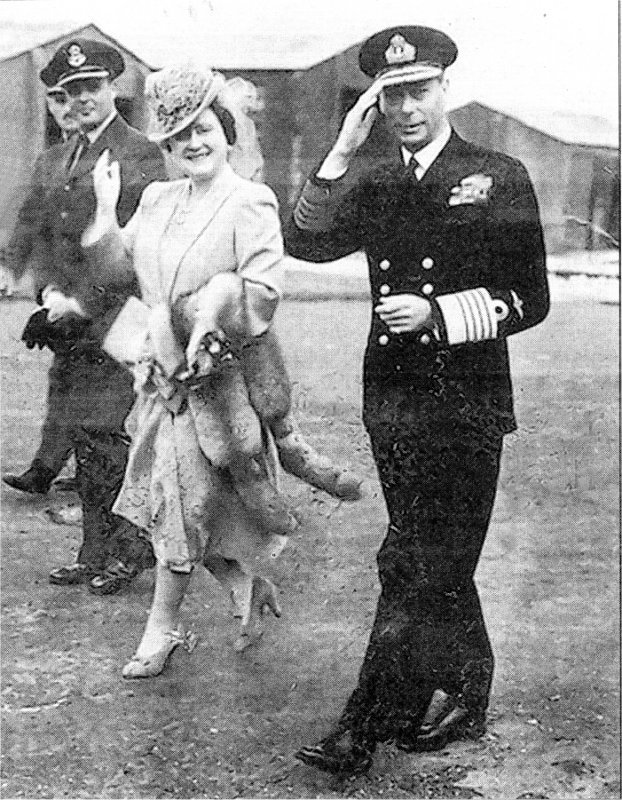
| King George VI and the Queen Mother on a visit to Long Kesh Airfield. Photo courtesy of George Dixon. US02-711 SP |
 |
Canon Alex Cheevers has been investigating the history of the former Maze Prison and its connections to the local war effort. Following the recent celebrations marking the end of the Second World War, he writes about the history of Long Kesh and its connections to the D Day landings.
JUST a few weeks ago, before Christmas, Halftown Residents Association held a very successful historical exhibition in Lower Maze Hall.
To mark the Sixtieth Anniversary of the end of the Second World War they had brought together a whole series of historical exhibits from that period of history, but they didn't do it in just a general way.
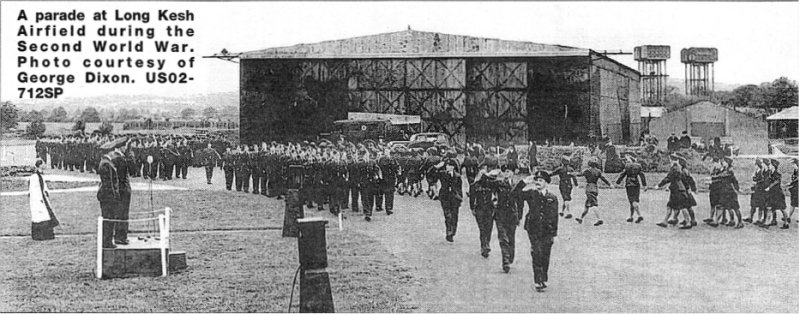
They made their exhibition local and special, because they also had compiled a whole array of documents referring to the time when, during the Second World War, the site of what until recently was Her Majesty's Prison, Maze, was a very active wartime airfield.
Anyone who carefully "looks around them" in the vicinity of what used to be the main entrance to the prison will see reminders of those days - the remains of a portion of old concrete perimeter runway, and also one of the old traditional red-brick Air Force multi-use single-storey buildings.
Over the years of the war the airfield was used for a variety of military purposes. However, the common factor in many of the uses to which the air-field was put was the training of young airmen.
Surviving
There were so many skills these young men had to learn if they were to serve their country well, and if they were to have a reasonable chance of surviving the war.
Sadly, not all of them did survive. In fact, many of them died before their training was completed.
That is not really surprising when you consider that all these young, inexperienced flyers were flying around learning their skills in a land which included several mountain ranges.
Documents in the War Memorial Building Museum in Waring Street in Belfast show that, during the course of the war, over one thousand young airmen, flying from various airfields in Northern Ireland, lost their lives in flying accidents.
While there may be the occasional memorial here and there where some of these men died, the only memorial to all of those men is to be found not far from Long Kesh, in Eglantine Parish Church, in the form of a stained glass window.
It is right that these airmen are remembered there, because even though they did not die in battle, they lost their lives in the overall war effort. And we have to remember too that those young men are just a very small percentage of all those who paid the horrendous price for the victory we have celebrated this year.
The importance of Long Kesh to the war effort was emphasised by a visit of King George the VI and Queen Elizabeth when they flew in to Long Kesh to encourage all those who were serving there at that time.
But what is the connection of Long Kesh airfield with D Day? Well, when the Allies were planning the June 6, 1944 invasion of Hitler's Fortress Europe, they knew that within a few hours they would have to pour massive numbers of men in to Normandy.
Many of these troops would land on the five designated invasion beaches - Sword, Juno, Gold, Omaha and Utah. But as well as that, the Allies needed to land thou-sands of men from the air behind enemy lines.
While some of these men would jump out of aircraft and land as specially trained paratroopers, many more of them would be ground troops who were trained to land in gliders.
These gliders were towed by tug aircraft to near the target area and would then be released - to land relatively silently, keeping the element of surprise - and often bringing with them heavier armaments and equipment than could be dropped in those days by parachute.
The glider pilots needed exceptional training for the job they were going to do. And Long Kesh was one of the destinations used by the Royal Air Force for training those who were to be Glider Pilots at D Day.
What often happened in training was that the "tug" aircraft left their home bases in the South of England, towing their gliders. They flew north over England, then turned west and navigated their way across the Irish Sea. When they picked up the shoreline of Northern Ireland they then had to navigate their way to Long Kesh - and release their gliders at the proper time to allow them to come in to land safely on their target.
Training
All good training for the up-coming D Day when they would have to fly over land, then cross a similar patch of water (the English Channel), make land-fall, and finally pick out their target and land at exactly the right spot. One of the vindications of all the training of the glider pilots was when six gliders carrying men of the Ox and Bucks Regiment landed just after midnight on D Day and captured two bridges over the Orne Canal (Pegasus Bridge) and the Orne River.
Several of the gliders landed within a few yards of the bridges, giving the invaders the complete surprise they needed. The 1st Battalion of the Royal Ulster Rifles was part of the overall 6th Airborne Division, which landed in Normandy at D Day, the Battalion landing not far from Pegasus Bridge. And the Glider Pilots also paid a high price - thirty-four of them died on D Day.
In our own local area today there is an increasing interest in the history of the Second World War.
This is obvious from the exhibition staged at Lower Maze, and similar ones held in various other local places to commemorate the end of the war. But another way in which this interest is seen is through the number of people who want to visit for themselves the places where history was made during that period in France, Belgium, Germany and even further afield.
Each year I, retired Rector of Magheragall, have found that the tours I organised to the D Day Landing areas and beaches of Normandy, also taking in the area of the Battle of the Somme from the First World War, have been fully booked. And even though we have only just broken in to the New Year, this year's May tour is already well on the way to being fully booked.
Those who have been on one of the tours in the past all say more or less the same thing. "It was a once in a lifetime experience we will remember for the rest of our lives."
Why does a retired Rector lead these tours? Since I was a child I had a passionate interest in the history of the two World Wars in Europe.
Over the last twenty-plus years myself and my wife Maureen have been visiting these sites year after year while we have been in France on holiday with our caravan.
Today it gives me a lot of pleasure to be able to share my knowledge of these areas, and to be able to help others experience them for themselves
And, above all, it is my own personal tribute and mark of respect to those who fought and died to win for us the freedom we enjoy today.
Whether they died flying out from Long Kesh, or whether they died on foreign soil, they all paid the same price.
If anyone would like any more details of this year's D Day Trip it will be held from Sunday 21 to Saturday May 27. I am also leading tours to Dunkirk, Ypres and Arnhem, and one to Auschwitz and Colditz.
The Rev. Canon Alex and Mrs. Maureen Cheevers can be contacted at 028 9269 0701 for further information.
Ulster Star
13/01/2006
