

ALEXANDER COLVILL WELSH
by Gilbert Watson
Alexander Colvill Welsh had an established business as a glazier and painter in Dromore, Co. Down in the nineteenth century but he enjoyed a much wider reputation for his collection of antiquities. He was the son of William Welsh of Dromore who married Jane Dickson the daughter of Joseph Dickson and Jane Colvill, and the great-grandson of Dr. Alexander Colvill. His paternal grandfather was George Welsh who was born in Moira in 1720 and is buried in the Cathedral grave yard at Dromore along with his two wives.
 Alexander
Welsh was also married twice. Firstly to Mary Trail by
whom he had three children; Anne Blackwell, William and
Jane. Mary died in 1838 and he married secondly Anne
Frazer by whom he had four daughters, Anne born 1844 who
married John Ellis; Alice Margaret born 1848; Elizabeth
Harberton who married a Mr. Finlay; and Alice Jane born
1855 who married Richard Watson of the Maze.
Alexander
Welsh was also married twice. Firstly to Mary Trail by
whom he had three children; Anne Blackwell, William and
Jane. Mary died in 1838 and he married secondly Anne
Frazer by whom he had four daughters, Anne born 1844 who
married John Ellis; Alice Margaret born 1848; Elizabeth
Harberton who married a Mr. Finlay; and Alice Jane born
1855 who married Richard Watson of the Maze.
Welsh was a well known and respected collector and antiquary and was very knowledgeable on the history of Dromore and it is unfortunate that little of the vast store of knowledge which he possessed is on record. He was in correspondence with another noted collector Dean Dawson of St. Patrick's Cathedral, Dublin, during the 1830's and together with John Roggan of Ladies' Bridge was instrumental in providing further material from the North of Ireland for the Dean's collection.
Welsh viewed the Dean's collection during a visit to Dublin in 1839 and he was so impressed by what he saw that he admits in a letter that his own collection was lowered in his estimation. The Dromore collection of artefacts was viewed in the mid 1800's by John Roggan, who was so impressed with the great variety and number of articles that he composed and published "A Quaint Catalogue of Antiquities in the collection of Mr. Welsh, Dromore," which is written in rhyming couplets. The full catalogue is given below and indicates what a valuable museum of treasures was once housed in Market Square.
| Huge folios and quartos, heaped
pile upon pile, Then beautiful paintings in every style; With maps of all countries and charts of all seas, He sees the whole globe while he sits at his ease, Can trace all its mountains, each river and lake: Describe every people, their colour and make- With beast, bird, and insect, fish, reptile, and all That have an existence on this earthly ball. His fossils are numerous, many, and rare Even teeth of the lion, rhinoceros, and bear, The head of an otter, and one of a fox, Petrified hard as the primitive rocks; Fragments, once oak, now certainly stone, Petrified holly used oft as a hone; Petrified ash and petrified yew, Petrified thorn, and sycamore too; Petrified urchins and petrified snakes, Petrified fish, from both rivers and lakes: Oysters and razor fish, too, petrified, And limpets and muscles, and cockles beside; Univalve, bivalve, and multivalve shells, Curious stalactites, from grottos and cells; Dendritics zoophytes, and belemnites too, Corals and corallines, white green and blue, Surphurs and salts, native metals and ores, Curious pentacrinites, fine madrepores, With some of the gems of Lough Neagh's sandy shores. A pebble, the finest from Lough Lean, And a neat little emerald of beautiful green; Schists, fluors, and quartz, a handsome actite. Silex, amygdaloid, ochre, and granite; Gypsum, and pieces of Derbyshire spar, And marble of various kinds from afar. His boxes of earths all differ in hue, From argill's dark red to fuller's pale blue; 'Tis pleasing indeed to hear him explain The kinds best adapted for each kind of grain. Ninety-eight amulets and thirty-two beads, Many of which were used as decades In form, orbicular, octagonal, square, Of crystal, of amber, even pearl so rare. Pieces of crosiers, a rare crucifix, An old broken mitre, a chalice and pix; A font was dug up near the Abbey of Saul, And an old heathen idol, the rarest of all; The pan of censer, of bronze finely polished, Found near a church fierce Cromwell demolished; And a square iron bell, so injured by time, No effort will cause it to yield the least chime; The parts are united with rivet and solder, Than the famous Clogroe it's undoubtedly older. Of rich polish'd brass, a rare antique vessel, I'm led to conclude it the bowl termed "wassail," Brought here by some Anglo-Saxon invader, Or left on our shore by an adventurous trader. Two beautiful methers, a carousal cup, From which the fell Ostman his boir would sup, From heather fermented - so potent the juice, Great draughts would inebriate and madness produce; The blood thirsty Pagan, with gore-covered steel, Would then make the natives his tyranny feel; Nor ceased hath tradition the hardships to tell, In those cruel times our forefathers befel. Say, muse, were the bridle, bits, stirrups, and spurs, Used in King William's or Oliver's wars, They may have belonged to some knight of old Bessie, Or seen the famed fields of the far famed Cressy. He has pieces of greaves, shirts of mail and vambrace, A vizier and some other guards of the face, Old gorgets and helmets, the half of a shield, And a part of a sword from Canne's dread field; Bills, battle-axes, old spears, and old skeans, And dirks that were used on Colloden's Plains; A gauntlet and glove near eaten by rust, Were used in the days of Richard the First. Of brass he has seventeen beautiful celts, With sockets and ears, which hung from the belts Of others quite plain exactly a score, And hatchets of stone a hundred and more; Of flint he has arrow heads, lances and spears, The tedious collection of many long years. A terrible axe was in sacrifice used, When the Flamin the reason of mankind abused- Six inches broad, half a cubit in length, Of stone finely polished and form'd for strength; A statue of stone was found near the Nile, An Egyptian god executed in style; Beautiful Lachrymatories, well formed urns, Adorned with lines of most curious turns; An hundred old pipe to the Danes some ascribe, Others doubt that they ever belonged to that tribe. He has various stone mills, one a beautiful quern, Long, long, were they used by the sons of old Erin. Two internal mummies of well baked clay, And a Borneo idol to him found its way. He has beautiful bracelets, brooches; and rings, Which were worn of old by our Queens and our Kings; A rare antique pin of Corinthian brass. The head ornamented with fine ancient glass: Such fastened the mantles of heroes of old, And some were of silver and many were gold; A large oval button of high polished jet, Surmounted the pin where the Mantle folds met; Two curious loops of the precious ore, To fasten the doubtlet that Monarchs oft wore. Of old Irish slippers he has got a pair, Without sole or heel, to meet with how rare; With thong most ingeniously stitched in front, But one has some curious carving upon it. Of matwork a singular fragment hath lain In earth, I presume, since time of the Dane, Most curiously wrought by some masterly hand, Its original use how few understand: 'Tis compact in the texture as cloth nearly fine, The fabric is wood, undoubtedly pine; A part of a skull in an urn was found, An inch near in thickness, and perfectly sound, That centuries ten must have lain in the ground; He has medals, medallions, and coins new and old, of silver, of copper, of brass, and of gold; Of gold he has seventeen coins mostly rare, Three hundred of silver, some round and some square; Of copper five hundred, one hundred of brass, When James abdicated he caused here to pass; The coins of the Popes our notice first claim, I'm told that precedence is due to the name, I think he has some of the fourth Adrian, With others quite down to the last reigning King; The Emperors next of course come in view- of these he has German and Russian too, And handsome Napoleons also a few; A handsome medallion of Charlemagne, With coins struck for Prussia, Poland and Spain, A few struck for Sweden, by Charles and hot, And some by that traitor to France, Bernadotte; A number of those by the fell Bourbon Line, With Burgundy, Tuscan, and Austrian fine; Dalmatian, too, must be added to these, And some of the Sultan's and some Portuguese; Of Venice, Genoa, the Sicilies some, And from Switzerland, Holland and Belgium they've come; Of Charles the Rash, a beautiful coin, Of William's a few, who fought at the Boyne; Of all of the George's, of Mary and Anne, Henry the Third, Seventh, Eight, and King John; Two of the Edward's One, five the Confessor, The Charles's Bess, and James the transgressor; A beautiful sample of Scottish produce- Alexander, the James's and David, and Bruce; The coins of Old Erin appear, but, alas! Of these he has few, save of copper or brass, along with her rights her Antiquities fled, Save such as she sunk round the graves of her dead: what escaped the hand of the Ostman, so rude, Was spoiled or destroyed by the bold Saxon brood; Poor Man, too, exhibits here three brawny legs, To be classed among Nations most anxiously begs; When the coins of all Nations he marshals in ranks; There's nothing but copper appears for the Manx's; Thou Yankee, brave people, who would dare to be free, He has paper and silver abundance of thee; The arrows, the eagle, holds firm in its claws, That Europe's proud despots triumphantly awes; Thy coins, too, brave Hayti, tho' sable, thy race. In his cabinet holds a conspicuous place; Demerara, the Brazils, Barbadoes of thee, He has many coins, and a handsome rupee; Batavia, Java, and fertile Ceylon, Thy coins make the shelves of his cabinet groan; Thou far distant China, the nations how few Can boast an antiquity equal to you He has thirty-six of thy coins and thy medals, Some bearing thy Emperors, other thy idols; Tho' science its influence round thee hath shed, Thy millions with Priestcraft are basely misled; They worship in ignorance, tamely forego Their reason, and bow to the poor idol Fo; Besides the above he has many defaced, By whom they were struck, nor their dates can be traced; But still like the miser he adds to his store, Though blest with abundance he still craves for more; He digs up the Tumuli, raises the cairn, To find something rare, and more knowledge to learn; To search round the Cromlech, he long journeys takes, Pursues the meanderings of rivers and lakes; If fortune some antique will cast in his way, His toil and his trouble it will more than repay; The caves deepest corners he bravely explores, In quest of some curious' crystals or ores; Among Druid's circles, old mouldering towers, He spends with delight some laborious hours; Or seek old entrenchments, the place of the slain, Perchance to find something of Saxon or Dane; The abbey's wild ruins incrusted with moss, The castle's rude walls, and the rath's ample foss He constantly visits with diligent pry In places like these, antiquities lie; So, indeed, very little escapes his keen eye. Now cease gently muse for a moment or more, Till I take a last look at this precious store; I view this museum as historic pages, Of artists, of heroes, of monarchs, and sages; Even too of old nature, whose curious hand Hath scattered such rarities over the land; Were medals but struck for the worthy of fame, No doubt Mr. Welsh to that honour might claim; But monuments crumble, and medals will rust, So his fame, worthy Sirs, to the muse we will trust. July 11th, 1840. |
Welsh's collection and interest was never static and his travels included visits to Dublin and Edinburgh. He was continually adding to the quality and variety of articles and a new pursuit in 1839 of collecting "different sorts of newspapers" was built up to 271 in a short time. His tenacity in the pursuit of artefacts is illustrated by his admission that it took over ten years to procure a square iron bell found in a Forth outside Dromore and his eventual success, in acquiring it from the lady owner, was the result of barter involving a silver crucifix which "she thought more useful." On another occasion, his business acumen is demonstrated in his attempt to acquire an inscribed bell (the Clog Ban) from a catholic family by enlisting the support of his father-in-law who was "much thought of by the Roman Catholic party owing to his political principles" and was also intimate with the Priest who lived next door to the vendor.
At the British Association for the Advancement of Science Exhibition at the Museum, Belfast in 1852 Welsh displayed various exhibits and the following have Dromore connections.
- (a) Portions of an ancient conical Cap of closely woven rushes, found with a stone Axe, in Drumbroneth bog, near Dromore.
- (b) Three tri-handled cups, of black glazed pottery, found in the original burying-ground of Dromore.
- (c) Illustrative American Indian Arrow-head of flint, with which the late Dr. Gillmer, of Dromore was wounded in the leg.
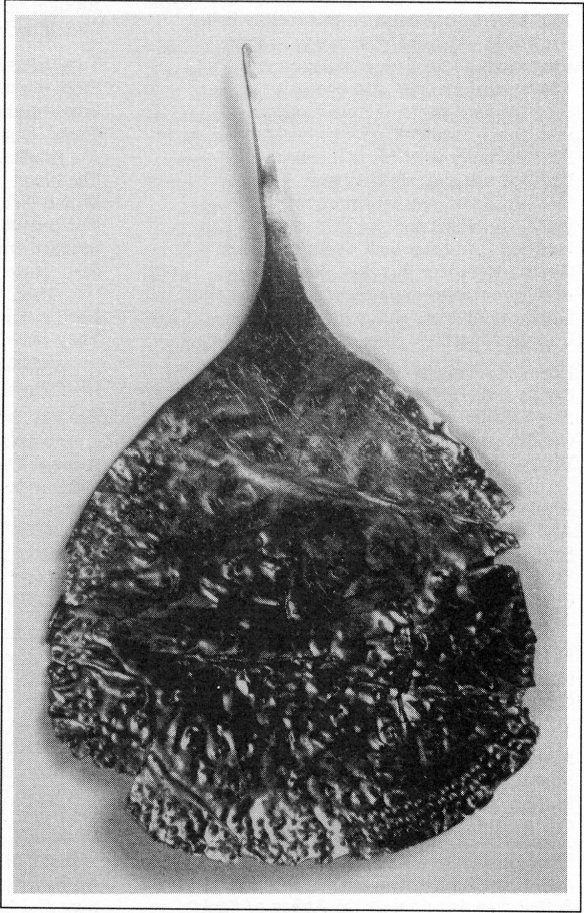
Part of Welsh's collection of antiquities was acquired by the Royal Irish Academy in March 1876 and was subsequently transferred to the National Museum of Ireland in the late nineteenth century. It consisted of some several hundred archaeological objects ranging from flint tools to bronze pins and brooches of the early Christian period and prehistoric period pottery vessels.
The following description of the gold ornaments in the Welsh collection is given in George H. Bassett's 1886 Co. Down guide and directory and the sites in the vicinity of Dromore where the specimens were found are recorded.
"In the Royal Irish Academy (Dublin) collection of Irish Gold Ornaments, are some from the County Down. They belonged to the late Mr. A. C. Welsh of Dromore. The first, a spoon shaped object, one and eleven sixteenths of an inch in width, and two and three-quarter inches long. It is slightly concave, and has a slender tang with triple row of small punched dots, near the edge. It weights two pennyweights and sixteen grains. The second was a bowed object and disc terminations and copper core; one disc gone. It was found at Edenordinary. The third is a specimen of ring money, a quarter of an inch thick and threequarters of an inch in diameter six pennyweights and three grains. The fourth is an unclosed hoop-shaped ring, with copper core having double longitudinal flutings. The core is visible to the extent of a quarter of an inch at the centre of the circumference. It is five-eights of an inch in diameter, a quarter of an inch in width, two-tenths of an inch in thickness, and weights two pennyweights and ten grains. It was found at Ballymacormack.
Welsh was aware of the value of his collection as his will dated 2 February, 1876 stated his intention "to make provision for my wife and her children by my second marriage by the sale of my antiquities and curiosities and therefore they are not named in this my will as Legatus." The beneficiaries were his own son William, his daughter Jane and his nephew William Price. The will gives an indication of the property he possessed, namely a tenement in Market Square occupied by Hugh Herron, a tenement garden in Gallows Street, a house in Mount Street occupied by Betty Jane Kennedy, a tenement in Gallows Street consisting of two houses and gardens occupied by David Thompson and John Prentice as well as his residence in Market Square.
Welsh's knowledge of Dromore has already been referred to, and one of the few known articles by him is a letter dated April 24, 1843 published in The Nation newspaper on the subject of The Break of Dromore. The same account of The Break is given in a footnote to the Montgomery Manuscripts by the editor the Rev. George Hill who refers to the account coming from an unsigned letter dated 24th April, 1843 found among the papers of the noted historian Mr. Samuel McSkimin of Carrickfergus. The account is that of Alexander C. Welsh and his letter to the Nation was probably at the request of the editor John Mitchell, the Young Irelander. Welsh would have known Mitchell as his cousin Robert Dickson was married to Mitchell's sister. The introduction to the newspaper article is probably by John Mitchell.
"The following curious and valuable information we have just received from a Conservative friend, who, in adverse circumstances, has acquired a knowledge of history, art, and numismatics, a collection of antiquities that might excite the envy of many a man with a great name:
April 24, 1843
