

Marquis Of Downshire Gets In Touch With Parish Priest
Descendent of chapel benefactor sends best wishes on 200th anniversary
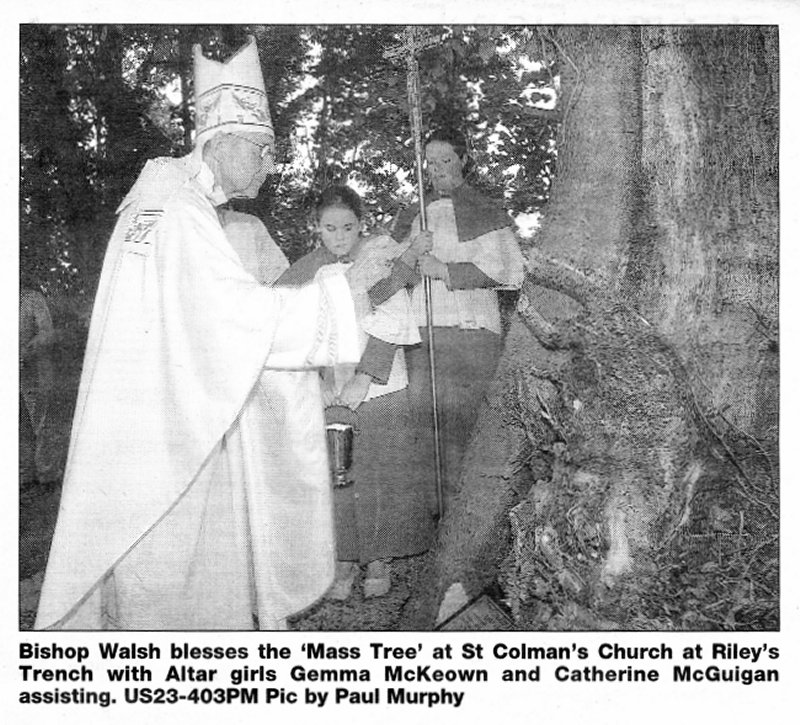 AMONG the many good wishes Parish Priest Fr Sean Rogan
received on the 200th anniversary of St
Colman's
chapel at Riley's Trench one stood out as a little
different.
AMONG the many good wishes Parish Priest Fr Sean Rogan
received on the 200th anniversary of St
Colman's
chapel at Riley's Trench one stood out as a little
different.
For it came from the ninth Marquis of Downshire, whose ancestor gave land and money to Blaris Parish to help them rebuild a chapel after the original building burned down in the 18th century.
The Marquis sent his best wishes to the parish on the anniversary of the church which replaced the building was burnt to the ground sometime between 1742 and 1745.
On Tuesday evening, appropriately on the Feast of St Colman, Bishop Patrick Walsh celebrated Mass at the historic church.
Among the congregation were the Rev. William Nixon from the Church of Ireland in Hillsborough and Presbyterian Minister the Rev John Deveney. After unveiling a plaque, Bishop Walsh planted a tree near the Mass Tree which was used by Catholics between the loss of the original building and the opening of the 'new' church in 1805.
Fr Rogan said he was delighted to receive the letter from the Marquis of Downshire.
"To think that now six generations on, the Marquis sends us his best wishes on the 200th anniversary of our church is quite remarkable" he said.
St Colman's Reilly's Trench is described in the 'Hillsborough - A Parish in the Ulster Plantation' by John Barry as a church of 'considerable antiquity.'
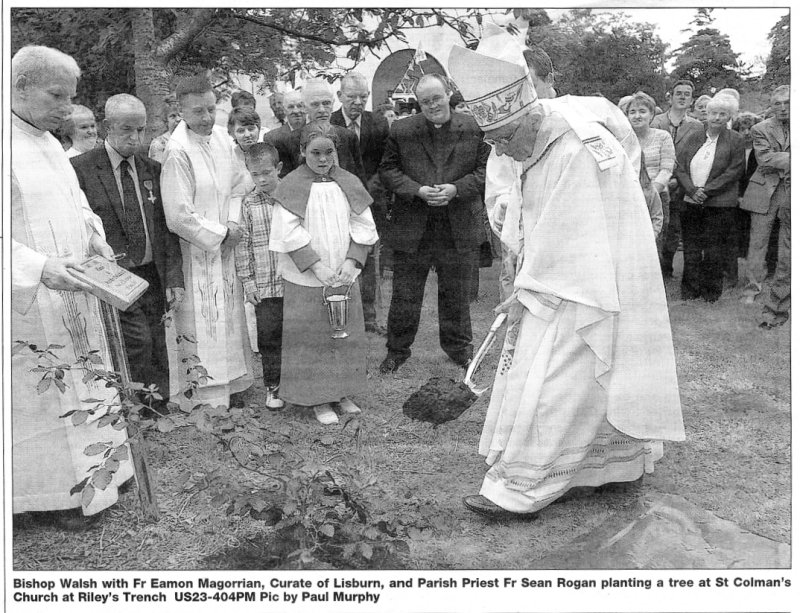 The
original church was burned down between 1742 and 1745. The
parish priest who resided at Blaris and was over Churches in
Trummery and Hillsborough was also driven out of his home.
The
original church was burned down between 1742 and 1745. The
parish priest who resided at Blaris and was over Churches in
Trummery and Hillsborough was also driven out of his home.
From then until the opening of the church in 1805 worshippers prayed at the Mass Tree in the grounds of the church where it still stands today.
In 1805 Marchioness of Downshire, touched at the plight of the Catholics, obtained a small portion of land from a family. She gave the land with �50 towards the building of the new church during the ministry of Father Devlin.
In 1832, the third Marquis of Downshire gave three roods and ten perches to be used as a graveyard.
In the book the chapel is described as a 'stone roughcast whitewashed building with a painting of a crucifix over the altar.
"The floor was partly boarded and partly mud. The parish priest, Rev Smyth and the church seated 300 people with the average attendance of 250. "The graveyard surrounding the area chapel is enclosed with a quickset fence and the entrance from the road by an iron gate. Oldest gravestone is 1831."
The book also mentions that a school was also built in 1814 but not used until 1829.
10/06/2005
