

The Maze Racecourse
by F G. WATSON
The peace and tranquility normally associated with the quiet fields that stretch along the river Lagan would regularly be disturbed by the bustle and throng of people attending the race-meetings. Since the 18th century the tenants on the Watson farms on the Cockhill Road and Dunnygarton Lane would have been subjected to the influx of visitors and travellers from all over Ireland converging on the race course. On main roads and bye roads, they came on horse and on foot and in all types of transport from splendid coaches, gigs and traps to the tradesman's cart specially fitted up for the occasion.
 |
 |
|
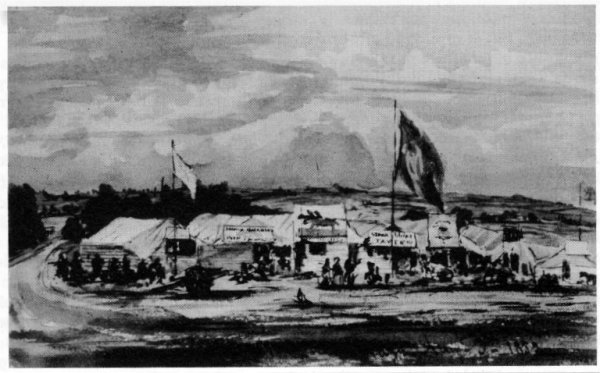
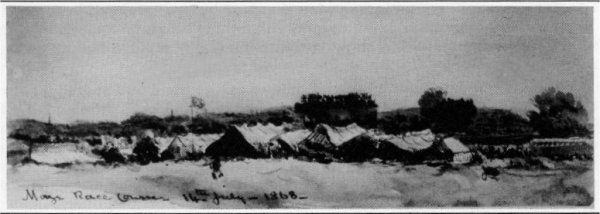
The gifted amateur James Moore M.D. Hon. R.H.S. (1819-1883) provides us with two accomplished and vivid watercolour sketches of the Maze racecourse dated August 3rd 1852, and 14th July 1868. Reproduced by permission of the Ulster Museum |
|
Dunnygarton Lane meandered through the course itself and it is easy to imagine the carnival atmosphere that would prevail on the occasion of a holiday in the general area with excitement for rich and poor alike. Farmer, weaver, artisan and labourer would mingle with the Gentry on these great occasions as they headed for the colourful flag bedecked tents of the stewards, saddlers, fortune tellers, gambling side shows and taverns.
The origins of the course are much older as a patent to establish a Corporation of Horsebreeders for Down had been granted by James II and the racecourse at Downpatrick had been formed in 1685. When William III, the Prince of Orange, visited Hillsborough Castle as the guest of William Hill he issued a letter to Christopher Carleton the Collector of Customs at Belfast granting £100 to be known as the Kings Plate and to be competed for at Hillsborough.
William Hill established the course at the Maze and his heir the Right Honourable Michael Hill implemented improvements and took a keen interest in racing blood stock. Walter Harris writing in 1744 gives us a brief description of the course.
"The Maze-Course, a place set apart for the publick diversions of horse racing, is upwards of a mile North of the town, near the banks of the River Lagan. A rising hill in the middle of the course, about two miles in circumference, give the spectators a full view of the whole field, and on the top of the hill a wooden tower is erected, open on all sides, for spectators to sit and view the course."
This original tower or stand was a wooden structure but was replaced by a round white washed stone tower on Tower Hill. The original hill formed a natural vantage point for the spectators and in earlier times it was not unusual for them to cut a flat hearth into the slope and cook over a lighted fire while they viewed the races.
The slope of the ground was the cause of many a fall as the crowd surged forward with excitement to see the closing stages of a race. Just before the races in July 1775 Mr Perfect an itinerant Methodist Minister preached at Halftown and during the sermon warned his congregation not to attend the racecourse, which was the scene of so many crimes and numerous calamities. The following eye witness account is provided by Patrick Cunningham who ignored the warning (horse racing being his favourite sport) but refrained from attending the Sunday races.
"The first day of the races presented a most shocking scene perhaps not less than one hundred thousand people all confusion and uproar. This was occasioned by a quarrel between the men of Broomhedge and those of Hillsborough. They armed themselves with whatever weapons they could get, and rushed upon each other with the ferocity of wild beasts, and fought with the greatest desperation. Such rage and clamour I never witnessed before. In a little time many of them were weltered in their own blood. I remember one only killed on the spot, but several died afterwards of their wounds."
Cunningham's assessment of the crowd is questionable but the racecourse was at its peak between 1811 and 1825 and its patrons included Lord Castlereagh, The marquis of Downshire, The Marguis of Donegall, Lord Portarlington, Lord O'Neill. Colonel Sparrow of Tandragee Castle, Colonel Cope of Loughgall, J. W. Maxwell, Nicholas Price, Colonel Forde. Sir S. May, Sir Robert Bateson, Messrs Whaley, McCance, Savage, Batt, Verner, Greg, Martin, Fivey, Moore, Nugent, Hall and Shaw indeed the men of note in the province.
James Watson Esq. of Brookhill was a popular leading huntsman and local contestant at both Downpatrick and the Maze. His last race at the Maze was on 12th October 1825 when he competed for the County Cup on a twenty year old favourite of his called Violet. He was at this time over 60 years old and retired as a winner. Jockeys were used at the course but in addition Gentlemen such as Watson and his brother-in-law Mr. Wakefield rode their own horses.
Over the years the standing of the Maze as a Social occasion reduced as it was plagued by criminal elements both male and female. Personal attacks and robbery were identified with the periodical meetings and on a further occasion murder, despite the efforts of the Marquis of Downshire. This occurred when a serious fight developed and the Marquis of Downshire attempted to defuse the situation by having one of the ruffians removed from the ground in his own carriage. The man a strong powerful individual was incensed by his Lordship's action and breaking loose jumped from the carriage and returned to the affray where he was stabbed to death. When his pregnant wife was informed she took ill and also died.
Race days would have been exciting times for the Watson families of the area as they punctuated the routine of the working year. With the crowds departed the fields would resume their quiet peaceful form, just as they remain to-day for Mamie Hewitt nee Watson whose house overlooks the course, and very much the same as they were when Richard Watson tended his cow and paid one shilling for grazing rights as is recorded in an account of grazers on the Maze Course in year 1777.
