

300 years ago today - Lisburn's worst catastrophe
 |
TODAY (Friday) is the 300th anniversary of the Great Fire of Lisburn which on Sunday April 20, 1707 burned the entire town to the ground. |
 |
It was one of the most momentous events in the town's history.
The fire was started accidentally in a house in an alleyway off Bow Street, and, fanned by high winds, spread widely within a few hours.
There were no emergency services in those days to fight the fire or to deal with the many townspeople who became temporarily homeless when their houses were destroyed.
The story of the Great Fire of Lisburn is one of stoic resilience in the face of terrible adversity, leading to energetic regeneration in the rebirth of Lisburn.
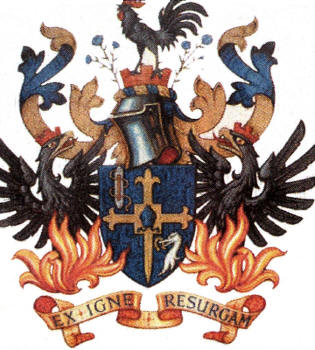
An important town, now a city, arose from the ashes and the significance of this civic spirit underpins Lisburn City Council's Latin motto `Ex Igne Resurgam' which can be translated as the following: `I will arise out of the fire:
This special feature on the day that helped to shape modern Lisburn has been produced by the staff of the Lisburn Museum
Blaze broke out on a Sunday morning
 THE fire in Lisburn broke out on a Sunday
morning at 11am when many people may have been at church,
leaving their homes unoccupied.
THE fire in Lisburn broke out on a Sunday
morning at 11am when many people may have been at church,
leaving their homes unoccupied.
Most of the buildings in 17th century town were made of timber and plaster work and roofed with thatch or wooden shingles.
These materials burned easily. Only the grander houses were of stone or brick.
Tradesmen and shopkeepers lived above their premises and many of the goods stored at street level would have been flammable such as tallow, turf, cloth and yarn. Homes were lit by candles and, on dark nights outdoors, people used open flame torches.
Town fires were not uncommon - perhaps the best known example is the Great Fire of London in 1666 - but in Ireland only Dublin had a public fire fighting service.
An eyewitness report described how quickly and extensively the fire spread: "Only some turf ashes thrown on a dunghill, which a brisk wind blowing towards the town raised ... took fire and the wind continuing what it had begun, the whole town...was irrecoverably in flames...From that end [of the town] which leadeth to Moyra ...until you come to the other end near Belfast there is not a standing house except the Market House...yea, the flames flew from the castle into that part of the town that stood in the county of Down."
Thankfully, the Dublin newspapers reported no deaths due to the fire but it had a tremendous effect on daily life.
A local minister wrote in a letter: "This is a very sore and sudden shock and...I pray God you never experience the like. There are many families wholly broken and several had not so much as to buy bread to their children last market day."
Many people's jobs were affected. The linen manufacture of Louis Crommelin and his workers ceased temporarily when their houses and looms were destroyed.
Some of the Huguenot workers left Lisburn permanently while others accepted government funding to return to the town and start afresh.
Newspaper accounts spread the news of the fire and invited donations for the relief of families in distress.
Money was sent to the Lisburn clergy from church congregations in Ireland and England.
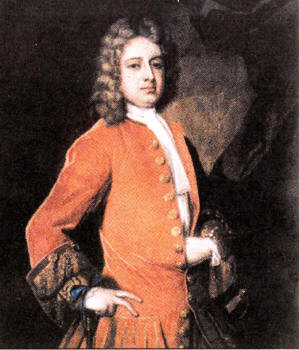
The landlord of the town, Francis Seymour-Conway, who lived in England, visited Lisburn and helped his tenants to rebuild their homes.
He granted a rent free period, renewed leases and also permitted free use of timber from his woods for rebuilding.
This encouraged the return of many of the families who had fled. It also attracted newcomers to the newly rebuilt town.
Lisburn rebuilt to its original 1600's street plan
AFTER the Fire, the town was rebuilt on the original 17th century street plan and assumed a newly improved appearance –'all brick houses, slated of one bigness, all new' – as brick replaced wood and slates and tiles replaced shingles.
The earliest buildings in the Historic Quarter date largely from that time and later.
The Market House, now the home of the Irish Linen Centre & Lisburn Museum is the only 17th century building which survived the fire.
A sandstone memorial plaque dated 1708, originally on the front of a new house in Market Square built by the Quaker, Jacob Hancock, is now on display in the Museum.
Its wording gives an insight into the respect for God and authority which was felt by the people of the time.
The crest which was adopted in 1964 by the then newly created Lisburn Borough Council preserves the memory of the town's response to the devastating disaster.
A visitor to Lisburn in the immediate aftermath of the fire likened the rebuilding which was taking place to the classical interpretation of the phoenix as a sacred firebird arising out of a fire.
The motto 'Ex igne resurgam' and the image of two phoenixes rising from the flames represent the rise and rebirth of the new from the ashes of the old.
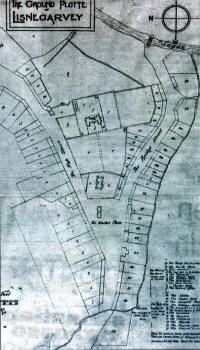
The earliest plan drawing of Lisburn, c.1630, which shows the street layout, the castle and the first church.
First established as a town in the early 17th century
LISBURN was originally known as Lisnegarvey and was established as a town in the early 1600s.
The Conway family was granted the land by James I in 1609 and began to lay out the central area of Market Square, Castle Street and Bridge Street - the area now defined as the Historic Quarter.
The Conways encouraged people from their estates in Warwickshire and Wales to settle in Lisburn.
Later in the century, Quaker families came from the north of England.
The developing linen industry attracted Louis Crommelin and other Huguenots from northern France and Holland.
By the end of the 17th century Lisburn was an
important commercial and military town, with a weekly market, a
school, a cathedral and local courts and assizes. Its population
was over 2000.
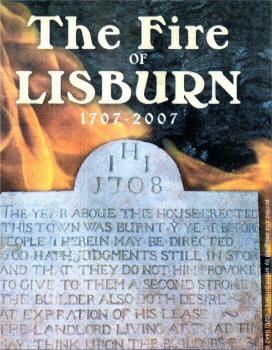
The leaflet produced by Plantation Road Gospel Hall showing the memorial plaque which commemorates the fire.
Gospel Hall marks anniversary of devastating inferno
PLANTATION Gospel Hall has used the opportunity presented by today's (Friday) Tercentenary of the Great Fire of Lisburn to spread the Christian message.
The congregation has marked the 300th anniversary of the catastrophe by publishing a leaflet which not only details what happened but also draws parallels between the fire and the message of the Bible.
For example, it explains the blaze which saw Lisburn reduced to ashes started 'in a very simple way'.
Quickly
However, it quickly spread until 'all people were affected by it'. The leaflet compares this to sin which it says started very simply in Eden's Garden but adds: "Its results are still spreading today." Continuing with this theme, the leaflet points out the way to be safe when fire breaks out is to
stand where the fire has been - the principle of the fire break - as flames will never pass over scorched ground that has experienced fire.
Spiritual
"So it is in the spiritual realm. There is a saviour who has been in the heat of God's judgement as my substitute," it adds.
The publication also draws parallels with the Crucifixion of Christ on Good Friday. Describing the fire as accidental, it says the 'Cross of Calvary was no accident of history'.
Instead, the author writes, it was God's 'immense purpose of love' to save perishing humanity from a burning hell.
Thousands of copies of the leaflet are being printed. Anyone wishing to receive a copy should request one on the website - www.plantationgospelhall.org.uk.
Ulster Star
20/04/2007
