

PARADISE REGAINED AT RAM'S ISLAND
In the first of a new series The Digger
looks at the fascinating history stories
that are all around
us.
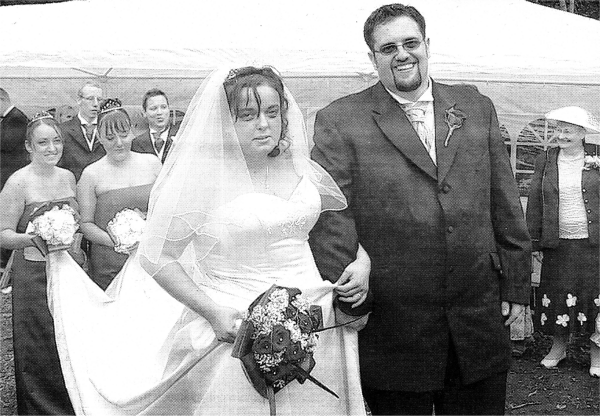
Robert McCormac and his bride. Victoria Savage, get married on
Ram's Island. US36-744SP
I REMEMBER hearing stories of my grandfather in his youth transporting several cattle from the shores of Lough Neagh to Ram's Island.
The legs of the cattle had to be secured for the mile long journey across the Lough.
At that time Robert and Jane Cardwell were living in the caretaker's cottage and were the housekeepers of the cottage used by the owners of the Island, the O'Neill family from Shane's Castle.
My grandfather's own grandmother was a Cardwell, although the exact relationship to the Island Cardwells is proving difficult to establish due to the lack of records available for that era.
Nearly a century later I was to take that same journey aboard the 'Island Warrior', a licensed passenger boat operating in Lough Neagh. I was to set foot on the uninhabited island which had previously been host to numerous visitors since the Island's occupation in early times.
We read that Wolfe Tone was certainly impressed by the Island's beauty whilst visiting there on 11th June 1795, so much so that he and his friends who were there on that date agreed that "whatever quarter we find ourselves, respectively, to commemorate the anniversary of that day."
The actor, film maker and author Richard Hayward, who died in 1964, described the bird life on Ram's Island in his 1938 book 'In Praise of Ulster'.
He wrote: "It is an ideal place for a picnic."
The Island can be viewed from an excellent vantage point at Crew Hill, Glenavy, close to an area where Richard Hayward was filming for part of the 1938 film titled "Devil's Rock."
More recently, however, on Sunday 6th August 2006 Robert McCormac and his bride, Victoria Savage, stepped onto Ram's Island to fulfil their dream of being wed there.
Their families, guests and onlookers gathered to witness what is believed to be the first wedding on Ram's Island in centuries. The ceremony took place in the romantic setting and backdrop of the 43 foot tall ancient round tower.
Victoria is the daughter of Michael Savage, an active member of both the River Bann and Lough Neagh Association and HM Coastguard Lough Neagh Coastguard Rescue.
Michael has been one of the main driving forces in the Ram's Island Heritage Project.
The association has taken out a 30- year lease on the island and its aims are to restore and care for the natural and built heritage of the Island including an education programme and making it more accessible to the public.
This is being made possible by a group of volunteer members of the River Bann and Lough Neagh Association.
I accompanied Michael on a tour of the Island. He was armed with a bill-hook which he from time to time swung at an invasive species of Himalayan Balsam which was eradicating the native plants.
In the space of several hours Michael gave me a fascinating insight into the history of the Island including an explanation of how the lowering of Lough Neagh over time had increased the size of the island from just over six acres to some forty acres.
I was to learn of the diverse range of flora and fauna on the island and the conservation methodology being used. The walls of the former O'Neill cottage are still standing under the shadow of the ancient round tower.
In the past both the tower and cottage were the victims of vandalism and the ravages of nature. The volunteers have been able to successfully prevent any further damage to the buildings by the pollarding of nearby trees with the necessary permission.
Rabbits, bat roosts, pheasants, beech trees, walnut trees, oak trees and toadstools that I passed by were just a small part of the species that have been identified on Ram's Island.
The Ram's Island Heritage Project Website currently lists a total of 55 different birds, five species of bat, 20 species of trees and 22 species of plant life identified on the island.
There is very little remaining of the cottage that was last inhabited by the Cardwell family but with the assistance of photographs taken in the early 1900s Michael was able to show me where it stood. When Michael told me the story of his visit to the Island on Christmas Eve in order to feed the birds I knew that with the dedication of people like him the possibility of the island being restored to its former glory was no longer a dream.
The website (www.ramsisland.org) provides comprehensive details of events, biodiversity, history, photo gallery and the ongoing conservation work taking place on Ram's Island. If you are interesting in volunteering in the project or visiting the island hill details are available on the website
Visit the Diggers new web site www.glenavyhistory.com
Ulster Star
08/09/2006
