

Exiles Forum

 
Google
 
Web www.lisburn.com
Lisburn, Co. Antrim, Northern Ireland


Lisburn Parish - Diocese of Connor

Lisburn Parish, Lisburn - Christ Church, Lisburn - St. Paul’s Parish Lambeg Parish Church
 

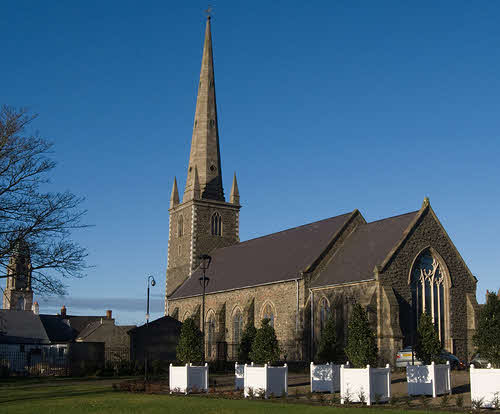
Lisburn Cathedral. The slim octagonal spire of the Cathedral is the tallest landmark in Lisburn. Interior of Lisburn Cathedral. The Rev. Canon Sam Wright pictured during morning service in this beautiful Lisburn City Centre Church.
Lisburn Cathedral. The original church called 'St. Thomas', was consecrated in 1623. The slim octagonal spire of the Cathedral is the tallest landmark in Lisburn.. Interior of Lisburn Cathedral. The Rev. Canon Sam Wright pictured during morning service in this beautiful Lisburn City Centre Church.


Rev. Canon Sam Wright Rector Rev. Ken McGrath Vicar
Rev. Canon Sam Wright
Rector
Rev. Ken McGrath
Vicar


Tony Hall Diocesan Layreader John Quigley  Diocesan Layreader

Tony Hall
Diocesan Layreader

John Quigley 
Diocesan Layreader


Keith Neill Youth and Outreach Worker Andrew Skelly Organist

Keith Neill
Youth and Outreach Worker

Andrew Skelly Organist

Lisburn Parish consists of the following three churches:
Lisburn Cathedral, Christ Church and St. Paul’s.

Lisburn Cathedral
Lisburn City Centre.

Rector: Rev. Canon Sam Wright
Telephone: 9266 2865

Vicar: Rev. Ken McGrath
Telephone: 9267 6499

Youth and Outreach: Keith Neill
Church Office Telephone: 9260 2400

Services:
Morning worship: 9.30am and 11.00am
Evening worship: 6.00pm
During July and August the congregation joins with some neighbouring churches for Summer Epilogue Services at 8.00pm.

Web Site:
www.lisburncathedral.org
 

Some of the musicians and vocalists that lead the praise at Lisburn Cathedral.  Pictured L to R are:  Michael Heaney, Michael Wright - Percussion, Jonathan Irvine - Guitar, Philip McConnell, Tim Webb, Des Henry, David Brattle - Keyboards, Francis Jess, Rosemary Irvine, Jean Craig and Jo-Anne Irwin.  (kneeling at front)  Frank Bailie - Music Co-ordinator and Jason Parker - Saxophone.  Missing from the photo:  Edward Craig - Organist. Harry Beattie - Church Sexton, pictured ringing the church bell at Lisburn Cathedral.

Some of the musicians and vocalists that lead the praise at Lisburn Cathedral.  Pictured L to R are:  Michael Heaney, Michael Wright - Percussion, Jonathan Irvine - Guitar, Philip McConnell, Tim Webb, Des Henry, David Brattle - Keyboards, Francis Jess, Rosemary Irvine, Jean Craig and Jo-Anne Irwin.  (kneeling at front)  Frank Bailie - Music Co-ordinator and Jason Parker - Saxophone. 

Harry Beattie - Church Sexton, pictured ringing the church bell at Lisburn Cathedral.


The stone tablet erected in the vestry of Lisburn Cathedral.

HISTORY

It is significant and suggestive that in 1608 when Sir Fulke Conway was granted the territory which included that upon which modern Lisburn stands, he built first a place to live and then a place to worship. The castle was completed in 1622, and the church was consecrated in 1623. The church was built on the site where the Cathedral now stands and was called ‘St. Thomas’. It was really a private chapel to the castle, and not at first a parish church.

This church was destroyed by the rebels in 1641. That was the year of the Irish Rebellion, which had as its aims the overthrow of English rule in Ireland, the recovery of the estates forfeited after the flight of the Earls in 1607 the extirpation of Protestantism and the establishment of Romanism. The town of Lisnagarvey, as it was then called, was attacked by a rebel army in November, 1641, and although the garrison was outnumbered and ill-equipped, so resolute was the defence that a notable victory was gained. The rebels, however, set fire to the town, and the whole town, including the castle and church, was burnt and left in ruins.

The church was speedily restored after the Rebellion. A gallery was added in 1674, and in 1697 it was decided by the Vestry “to raise £60 for the repair of the church and churchyard of Lisburn and also for enlarging the said church.” Alas for the sacrifices and schemes of the rector, the Rev. Joseph Wilkins, and his people for the town and church were again destroyed by fire in 1707. The fire began accidentally while the people were at worship, and spread with such rapidity that in a few hours the whole town, with the exception of a few buildings, was destroyed.

Among the buildings destroyed was the First Presbyterian Meeting House. It had been situated in the Longstone area, but after the fire a new site was acquired at Market Square, where a new Meeting House was erected and opened for worship about 1710.
Again the Cathedral was rebuilt. The foundation stone being laid the year after the fire. The spire was added in 1804 and the Chancel was built and consecrated in 1889.

In the year 1662, shortly after the Restoration, Charles 11 established the church “to be forever hereafter the Cathedral Church and Episcopal Seat of the aforesaid several bishopricks of Down and Connor.” Some years ago questions were raised as to the validity of the Charter granted by Charles II, and in order to remove all doubts as to the status of the Cathedral the Lord Bishop of Connor (the Rt. Rev. Charles King Irwin D.D.) introduced a Bill at the General Synod of the Church of Ireland in 1952. This measure recognised Lisburn Cathedral as the Cathedral of the Diocese of Connor, known as the Cathedral of Christ Church, Lisburn. The Cathedral is notable for its association with Bishop Jeremy Taylor, who held a lectureship in the Cathedral for a time, and was made Bishop of Down and Connor at the Restoration. he was noted for his scholarship and his writings, his two most popular works being “Holy Living” and “Holy Dying.”

When he became Bishop he set himself to restore the life and discipline of the Church of England in his diocese. He took strong action against Presbyterian ministers and in his first Visitation in 1661 he ejected 36 of them from their churches and residences. He died in Lisburn in 1667, aged 54, in a house in Castle Street, and there is a mural tablet in Lisburn Cathedral to perpetuate his memory.

The Cathedral is also notable for its association with the French Huguenots. The Huguenots had a place of worship, known as the “French Church,” situated in Castle Street, on the site now occupied by the Town Hall. Notable Huguenot names associated with the town and Cathedral are Louis Crommelin ‘the father of the Ulster linen trade,’ whose grave is in the cemetery adjoining the Cathedral; and the Rev. Saumarez Du Bordieu, the last Huguenot chaplain to the Huguenot congregation; master of the Classical School in Lisburn for 56 years; curate of Lambeg and vicar of Glenavy. When he died in 1812 his pupils erected both his grave-stone, and an impressive marble tablet and bust which adorns one of the walls of the Cathedral.

In 2003, the 1796 front gates were replaced and in 2004 the clock chimes were heard again. During 2006 the Vestry rooms were extensively refurbished, also flood lighting was been added.

The Rev. Canon Sam Wright was instituted as Rector in February 1999 and the Rev. Kenneth Mc Grath was instituted as Vicar (Development of new Ministeries) in January 2006. Tony Hall - a parishioner from Lisburn Cathedral, was commissioned as Diocesan Layreader in June 2006 and will serve in St Peter’s, Antrim Road, Belfast, for one year during training.

For a more detailed history of Lisburn Cathedral much of which is taken from the late W. P. Carmody's work, click on: Christ Church Cathedral Lisburn. A brief history

The above article is taken from a 1964 Ulster Star Supplement compiled by the Rev. J. McCaughan. To see the article in full, click on: Ulster Star borough Supplement then go to Section 2 of the supplement entitled “Flourishes in obedience to God’s Word, The Spiritual Borough.”

Also, a full history of the church by the Very Rev. W. P. Carmody. M. A. (1925) is shown on this web site: Click on: Lisburn Cathedral and its past rectors with an appendix.


Lisburn - Christ Church
 

Christ Church, Lisburn.

Christ Church, Lisburn.


Rev John Pickering Senior Minister Rev. Paul Dundas Rector Rev. Diane Matchett Curate
Rev John Pickering
Senior Minister
Rev. Paul Dundas
Rector
Rev. Diane Matchett
Curate

Lisburn - Christ Church
Hillsborough Road, Lisburn.

Rector: Rev. Paul Dundas
Telephone: 9266 2163
Curate: Rev. Diane Matchett
Telephone: 9266 5897

Sunday services:
Morning Prayer: 11.30am
Evening Prayer: 6.30pm
2nd Sun. Morning Prayer: 10.15am
Parish Communion: 11.30am
Worship during July and August will be at 10.30am.
Holy Communion:
1st Sunday: 8.30am
2nd Sunday: 11.30am
4th Sunday: 6.30pm
Saints Days as announced

Web site:
www.christchurchlisburn.com
 

Brian Littler Parish Reader.
Brian Littler
Parish Reader


Wesley Dickinson - Rector’s Warden and Ann Elliott - People’s Warden.
Wesley Dickinson - Rector’s Warden and
Ann Elliott - People’s Warden.

Christ Church Choir, Lisburn

Rev. Paul Dundas - Rector of Christ Church, Lisburn and Richard Yarr - Director of Music pictured with Christ Church choir.  L to R: (front) Sylvia Creighton - Choir Secretary, Richard Yarr – Director of Music, Rev. Paul Dundas - Rector, Jean McIlveen and Maisie Meenagh.  (second row) Norma Walker, Margaret Little, Daphne Sloan, Pauline Graham, Natalie Thompson and Doreen Berry.  (third row) Betty Wilson, Ann Elliott, Maureen Doran, Muriel Sloan and Hilary Torney.  (back row) Brian Littler, Eric Thompson, Eric Grangle, Tim Littler and Sam McIlveen.  Missing from the photo:  Renee Madden - Deputy Organist, Jean Briggs, Winifred Bell, Freda Scott, Ann Walker and Kelly Alexander. 

Christ Church Choir, Lisburn, have a long tradition of four-part choral singing. Besides leading church worship, this award-winning choir fundraise for the church through ventures such as concerts and cake-sales, and have even taken part in ‘It’s A Knock-Out’ competitions. They also enjoy an annual weekend away, exploring their more social side.  Mr Richard Yarr has been their Director of Music since 1992.


Notice Board at Christ Church, Lisburn. Stone panel above the church hall door at Christ Church.
Notice Board at Christ Church, Lisburn. Stone panel above the church hall door at
Christ Church.


HISTORY

In about 1840 there was a considerable increase in the population of Lisburn owing to the erection the Flax Spinning Mills and Threadworks. As the majority of the workers employed in these mills were professedly members of the Church of the Ireland, it was felt that an effort should be made to provide increased church accommodation in the town, by building a Chapel of Ease, in which free sittings would be provided for working people. Accordingly, a committee, composed of Captain Bolton, Messrs. William Caldbeck, David Beatty, and other gentlemen, was formed for the purpose. Application having been made to Dean Stannus, Agent of Hertford estate, for a suitable site, a field in the immediate vicinity of the town, on the Hillsborough Road, was placed at the disposal of the committee. The field offered was at that time in the occupancy of Mr. Parker Major, who, when waited upon by the Committee, generously surrendered his claim, and by handing over possession greatly facilitated the work which was in hand. In addition to the granting of the site, the Marquis of Hertford generously gave a donation of £400 towards the cost of erection.

Plans and specifications were prepared by the late Sir. Charles Lanyon. Two local builders, Messrs. Arthur Morgan and James Vernon, were appointed to build the edifice with seating for 500 worshippers, at a total cost of £4,800. The “New Church” as it then was called was opened for worship on 20th November 1842 and the special preacher was The Hon. and Rev. Henry Ward, Rector of Killinchy and son of the Second Viscount Bangor. The church is built of black stone, chiselled from a design of Mr. Laynon. The tower is a beautiful structure, 72 feet in height; it is of the ancient Gothic school of architecture, surmounted by castellated turrets.

During the first 21 years of its life, the “New Church” remained under the general control of the Cathedral of Christ Church, Lisburn, otherwise Lisburn Cathedral, as a Chapel of Ease, and its first Curate was the Rev. John Nash Griffin; followed in 1845 by the Rev. J. Hudson, whose incumbency was of a short duration. He was succeeded by the Rev. Hartley Hodson in 1846 who was appointed Rector of Derrykeighan in 1863.

After the Religious Revival of 1859, the North and south transepts and the gallery were constructed and the additions provided accommodation for a further 280 worshippers. At a special service on 10th June 1860, to mark the completion of the work, the special preacher was the Rev. John N. Griffin, the first Curate of the New Church, then Minister of Spring Grove, Middlesex.

A Deed of Endowment dated 15th September 1863, assigned a Pastoral District or Parish to the “New Church”. The church was consecrated on 24th September 1863 and the Rev. William D. Pounder, B.A. was appointed Perpetual Curate and Rector and held the incumbency for 21 years. In 1884 he was promoted to the Rectory of Lisburn

In 1864, the Nicholson Memorial Hall was erected for a Sunday School by Mrs. Nicholson in memory of her six children: James, Alexander, William, John, Lily and Charles. A statue in Market Square, Lisburn, commemorates one - General John Nicholson, of Indian Mutiny fame. On 31st October 1874, the Bishop of the United Diocese, the Rt. Rev. R. Knox, consecrated the Nicholson Memorial aisle. It was designed by Thomas Drew, and is a memorial to the late Mrs. Nicholson.

During the incumbency of the Rev. Canon Arthur Noble, M.A. (1961-82) a massive building and reconstruction and refurbishment programme was carried out involving expenditure of approximately £150,000. The old Nicholson Memorial Hall was completely modernised and a new minor hall, porch and games room were built and officially opened by Mrs. A. Noble and dedicated by the Lord Bishop of Connor, the Rt. Rev. A. H. Butler on 9th January 1976.

During the incumbency of the Rev. Canon Samuel McComb, G.O.E. (1982-2004) a further massive building and reconstruction and refurbishment programme was carried out on the church and its ancillary buildings, involving expenditure of over £1,000,000. In 1982 the porch of the church was rebuilt and enlarged, and is now known as ‘The Noble Porch’ as a tribute to the services of the Rev. Canon Arthur Noble, Rector. The church halls were renovated and on 3rd November 1995 the renovation of these halls were dedicated by the Lord Bishop of Connor, the Rt. Rev. J. E. Moore. The church was treated for the effects of dry rot and new pews and flooring were installed. In addition to these massive sums, the parishioners of Christ Church donated £26,000 i.e. half of the cost of its daughter church, St. Paul’s, Lisburn, which was opened in 1964. Over the years, the faithfulness and the generosity of the parishioners have been consistent and remarkable.

More recently the Parish built a spacious modern rectory on the traditional site adjacent to the Church. It cost £330,000 to build and was dedicated by the Rural Dean, the Rev. Peter Galbraith, on Sunday 16th October 2005. The key was passed by the young people from the church to the rectory and the key opening ceremony was performed by Dr. Samuel Semple, Samuel Bird and Emma Crowe.

Since 1863 the Parish has been served by 47 curates and 12 rectors. The present Rector, the Rev Paul Dundas, was instituted in January 2005 and the Rev Diane Matchett was ordained as Curate in June 2005 and was ordained Priest at a Service of Ordination in Lisburn Cathedral on Sunday 18th June 2006 and Brian Littler was commissioned Parish Reader in June 2006. The Rev John Pickering, formerly Rector of Drumcree Parish Church, was appointed senior minister in January 2008 in succession to the Rev Canon Dr Ken Cochrane, who left at the end of September 2007.

Compiled largely from the History of Lisburn and from research supplied (21st February 2006) by Dr. Samuel Semple.

Also http://www.lisburn.com/books/star_brochure/star_brochure2.htm  “Flourishes in obedience to God’ Word, The Spiritual Borough.”

Lisburn - St. Paul’s Parish
 

St. Paul’s Parish, Lisburn, consecrated in 1964.


Rev. James I. Carson Rector Mr Stephen McWhirter Pastoral Assistant Elizabeth Sloan Diocesan Layreader
Rev. James I. Carson Rector Mr Stephen McWhirter
Pastoral Assistant
Elizabeth Sloan
Diocesan Layreader

St. Paul’s Parish,

Rev. James I. Carson Rector
Telephone: 9266 3520

Sunday services:
Morning Worship: 11.30am
Evening service: 6.30pm
Family morning worship: 10.00am (2nd & 4th Sunday)
Holy Communion: 8.30am (2nd & 4th Sunday)

Web site: www.stpaulslisburn.org


Notice Board at St. Paul’s Parish, Lisburn.

HISTORY

St. Paul’s is a daughter church of Christ Church, Lisburn. The Parish was intended to serve the Tonagh estate, Moira Road, Ballinderry Road and the new housing estates planned for the area.  The present site was purchased by Christ Church in October 1959.  The Rev. Ken Cochrane became curate in charge of the new district of St. Paul’s in May 1962.  Two army huts were aquired with the help of the Army and erected in an L shape joined together by a kitchen area.  The huts were renovated by voluntary labour saving the church many thousands of pounds.  One hall became the church and the other the church hall and were opened and dedicated on Saturday 8th September 1962.

The foundation stone of the present church was laid on Saturday 10th November 1962 by Mr. Robert Boomer in the presence of the Lord Bishop (Rt. Rev. R. C. H. Elliott, D.D.) and the church was consecrated on 25th January 1964.  The building cost £40,000.

Having lived in temporary accommodation in Belvoir Crescent, the Rev. Ken Cochrane moved in 1964 to ‘Hawtree’, which was later to become the Rectory of St. Paul’s Parish.  He was instituted as Rector in January 1965 and St. Paul’s became a separate parish in 1966.  The present Parochial Hall was opened in May 1974.  The Rev. Ken Cochrane was appointed Canon of St. Anne’s Cathedral in 1986 and received his Doctor of Philosophy degree in 1988 and was appointed Canon of St. Patrick’s, Dublin, in 1990.  The Rev. Canon Dr. Ken Cochrane retired in December 1998 and became assistant to Canon McCombe at Christ Church in 1999.

The present Rector, the Rev James Carson, was instituted in June 1999. Mr Carson is assisted by Mr Stephen McWhirter, who was appointed Pastoral Assistant in November 2007 in succession to Associate Minister, Captain Gary Roberts who left St Paul’s in September 2007 to become Evangelist and Pastoral Assistant at the Ballymacarrett Group of Churches, Belfast. Elizabeth Sloan (a parishioner from St Paul’s) was commissioned as Diocesan Layreader in June 2006 and will serve in Broomhedge Parish for one year during training.

Souvenir booklet of the consecration of St. Paul's church by The Right Reverend R. C. H. Elliott, D.D. Lord Bishop of Connor 25th January, 1964 (THE CONVERSION OF ST. PAUL)

Lambeg Parish - Diocese of Connor
 

Lambeg Parish Church , consecrated in 1737. The Hilden Centre.

Lambeg Parish Church , consecrated in 1737.

The Hilden Centre.


Rev. Ken McReynolds Rector Mrs. Pat Harvey Pastoral Assistant in charge of the Hilden Centre.

Rev. Ken McReynolds Rector

Mrs. Pat Harvey
Pastoral Assistant
in charge of the Hilden Centre.

Lambeg Parish Church

(Ballyskeagh Road, Lisburn)
and The Hilden Centre, Hilden

Rector: Rev. Ken McReynolds
Telephone: 9266 3872

Sunday Services:
September - June
 

9.30 a.m.

Holy Communion  (Service 1) 2nd, 3rd & 5th Sundays

11.00 a.m.

Parish Communion

(Service 2)

1st Sunday
 

Morning Prayer

(Service 2) 2nd, 3rd & 5th Sundays


Morning Prayer (Service 1) 4th Sunday

6.30 p.m.

Evening Prayer (Service 1) 1st Sunday
  Evening Prayer (Service 2) 2nd, 3rd & 5th Sundays
 

Holy Communion

(Service 2) 4th Sunday

July - August
 

9.30 a.m.  Holy Communion (Service 1) Each Sunday
11.00 a.m. Morning Prayer (Service 2) Each Sunday
8.00 p.m.  Epilogue Service Each Sunday  


Hilden Centre:

11.30 a.m. Morning Worship 2nd & last Sunday  


Web site: www.lambeg.connor.anglican.org
 

HISTORY - Lambeg Parish Church

Historians tell us that a place of worship was in existence possibly as far back as 1306. The ‘Chapel of Lambeg’ was consecrated on 25th September 1737 and the only part remaining is the tower. In 1849, the church, with the exception of the tower, was completely rebuilt. In 1870, the church was enlarged increasing the seating capacity to 480.

HISTORY - The Hilden Centre

The Lambeg parish area also includes the Hilden Centre at Hilden. Prior to 1911, a Sunday school for the children of Hilden district was held in the canteen dining room of the Hilden Thread Mill factory. In 1911, Mr. J. Milne Barbour, Managing Director built the E.M.B. as a memorial to his wife Elise Milne Barbour and on 18th February 1912, it was handed over and vested in the Session of Railway Street Presbyterian Church. In 1996 it was sold to Lambeg Parish to be used for Church extension work. The E.M.B. hall was later demolished and The Hilden Centre was built on the same site. The E.M.B. hall was later demolished and The Hilden Centre, built on the same site, was opened in 2001. Mrs. Pat Harvey was appointed Pastoral Assistant in charge of the Hilden Centre in May 2000.

Churches Website:

Historians assure us that there were monastic foundations, in the vicinity of the present Parish Church, dating from at least the fifteenth century and that a place of worship was in existence possibly as far back as 1306.  However, the first definite mention of a Church is in 1598. A map of Ulster, made at that date and now in the possession of the British Museum, has “Lambeg Church” clearly marked.  Besides this, a tombstone bearing the date 1626, has been discovered in the Churchyard. The fate of the original small church is uncertain, but, it is reported to have been in a ruinous condition before the beginning of the Civil Wars, which marked the end of the reign of Charles 1 (1649).

The year 1737 is an important date in the history of the Parish.  On 25th September of that year, Dr Francis Hutchinson, Bishop of Down and Connor, consecrated “the Chapel of Lambeg” and licensed a Mr Arthur to the curacy. The Church was an oblong building, measuring sixty feet in length by eighteen and a half feet wide. It accommodated a congregation of less than 200. The only part of it remaining is the tower, which was then surmounted by a wooden cupola complete with weathercock.  The Church was completely rebuilt, with the exception of the tower in 1849 in the incumbency of the Rev. Alexander Orr. This was necessitated by the rapid growth of the population with the expansion of the linen industry. The old church was too small and could accommodate little more than one-fifth of the parishioners.

Just before the disestablishment of the Church of Ireland in 1870, the new church had to be enlarged to a seating capacity of 480 by the addition of a South aisle. The east end of this aisle was used as a chancel up to 1902 when at that date the old chancel was brought back into use.  The pulpit, sanctuary chairs and lectern were the gift of the then Rector, the Rev. Chancellor Banks, whose long incumbency dates from 1877 to 1929. The present organ, erected in the east end of the South aisle in 1903, is the work of Messrs.Conacher and cost £418. The church bell, purchased from Ballymena Parish in 1895, was cast in 1866.It weighs 12cwt. The Sexton's house was built at a cost of £210.

The Churchyard was extended in 1921 through a gift of land from Sir Milne Barbour. Over one and a half acres were added and new paths laid. New entrance gates were erected in 1924 and later a second entrance with a broad avenue leading to the church was made. There are many old graves and gravestones in the Churchyard, the oldest dating to 1626 and reading “Here lyeth the body of Margaret Wilson, wife of Donnell Savage, who departed this life the 24 April 1626”.

In 1933, electricity was installed in the church and in 1949 the interior was redecorated.  The Parochial Hall, which was opened in 1937, was a fitting conclusion to a long series of efforts, dating back to 1922, to raise funds for the project.  In 1946 the derequisitioned school at Tullynacross was presented to the Parish by Sir Milne Barbour for to be used as a Sunday School as well as other Parish purposes.

Some other more recent developments:

  • 1955 Old school at Church Hill demolished and car park constructed

  • 1957 New Rectory constructed.

  • 1964 Parochial Hall extended.

  • 1967 Church roof re-slated and major refurbishment of interior of church.

  • 1969 New robing room added

  • 1976 Major renovation of Church stonework

  • 2000 Extensive refurbishment of the church interior.

  • 2001 The new Hilden Centre opened

 The industrial ‘face’ of the Parish has changed greatly in recent decades with the demise of the linen industry and the disappearance of many of the mills and associated premises. However, these have been replaced by modern light industry ranging from the manufacture of soft drinks to Computers and business centres.  To-day Lambeg parish ministers to some 450 families, the majority of whom actually reside outside the geographical boundaries of the parish.

Much has changed during the centuries of it’s history, but it’s task remains the same - to extend God’s Kingdom in the hearts and lives of it's people and to encourage worship in His house.