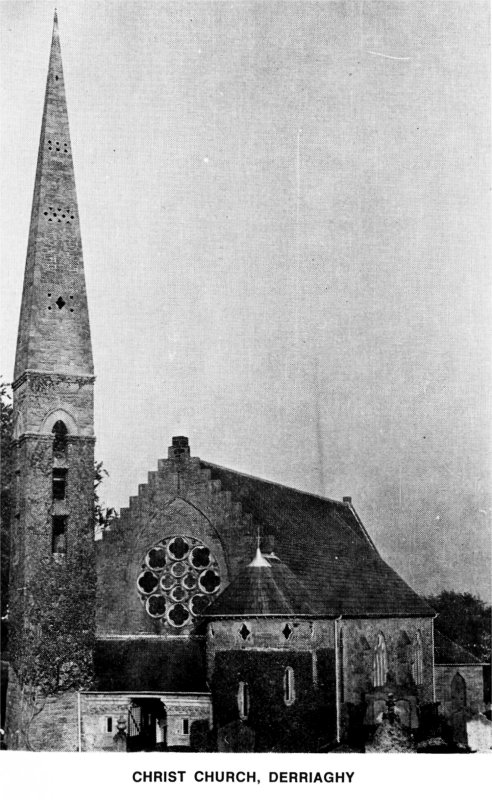
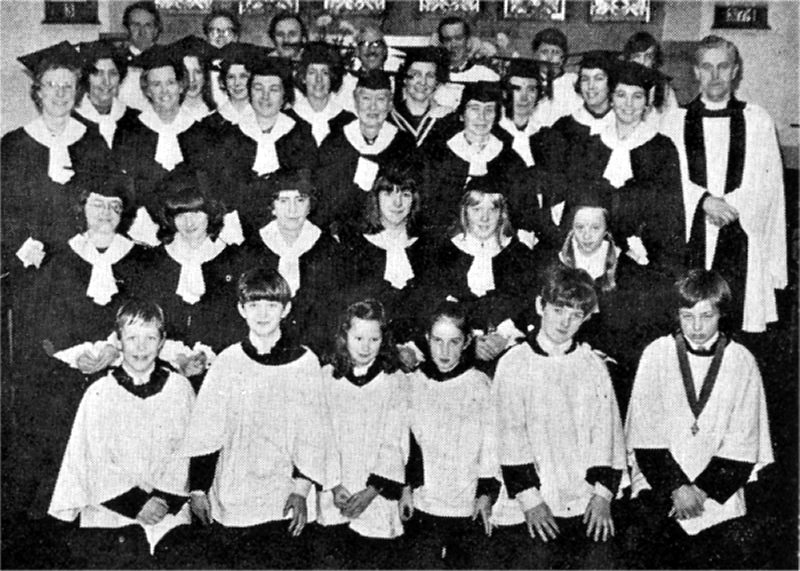
|
CONTENTS

CHRIST CHURCH DERRIAGHY
PAST AND PRESENT
The publication of this history, compiled to mark the Centenary of the consecration of Christ Church, has been made possible by the generosity of John F. McCall, Sons and Family.
INTRODUCTION
This short survey of the Parish of Derriaghy has been written to put on record the names of some of the people associated with the parish and their doings over the centuries. It was begun at the time of the celebration of the centenary of Christ Church in October 1972, but so great was the amount of material to be examined and sifted that only now, two years later, has the work reached the printer.
Two former curates of the parish, the Rev. G. O. Woodward, later Chancellor of Down, and the Rev. H. C. Marshall, who also became Chancellor of Down and now lives in retirement at Saintfield, were the first clergy of the parish known to have collected information about it. We are fortunate that both left notes of their work which we have been able to use. Mention should also be made of an article contributed in 1943 to the Ulster Journal of Archaeology by the Rev. J. L. Spence, then curate of the parish, entitled "Life in early eighteenth century rural Ulster as reflected in a parish record book"` and to a short history of the parish written by the Rev. D. J. O. Barr when he was curate here.
A further major source of information has been Parish records dating back to 1696. These include the minutes of the Vestry Courts and the general and select vestries which succeeded the Vestry Courts; there is a gap of 35 years between 1759 and 1794. In addition there are baptism, marriage and burial registers beginning in the late 17th century, though in the early years especially the information supplied is sketchy. A list of the Parish records is given in Appendix 1.
Other invaluable sources have been W. Reeves, Ecclesiastical Antiquities of Down, Connor and Dromore (Dublin 1847); J. O'Laverty, History of the Diocese of Down and Connor vol 2 (Dublin 1880); R. Mant, History of the Church of Ireland (London (1840); W. A. Philips, History of the Church of Ireland (Oxford University Press/Humphrey Milford 1934); D. H. Akenson, The Church of Ireland (New Haven & London: Yale University Press 1971); Ordnance Survey Memoir of the Parish of Derriaghy, shortly to be published (original manuscript of 1837 in Royal Irish Academy: microfilm in Public Record Office of Northern Ireland).
We are much indebted to the Representative Church Body for permission to quote from the Biographical Succession List of the Clergy of Connor Diocese compiled by Canon J. B. Leslie, D.Lit., a typescript in the Library of the Representative Church Body; to the Royal Irish Academy for the use of extracts from the Ordnance Survey Parish Memoir; and to the Dean of Armagh for permission to examine and quote from the 1657 Inquisition on the parishes of County Antrim in the Public Library, Armagh.
Valuable assistance in the preparation of the contents of the following pages has been given by Mr. D. Thompson, Mr. K. D. Levis, Mr. W. S. Corken, Mr. Stanley Hutchinson, Mr. Aiken McClelland of the Ulster Folk Museum, Mr. A. Harper of the Archaeological Survey of Northern Ireland, Mrs. D. Flanagan of the Celtic Department of Queen's University, Miss G. Willis, Librarian of the Representative Church Body, and the Public Record Office of Northern Ireland. We are particularly grateful to the Rev. C. Donnelly, Parish Priest of Hannahstown, for his comprehensive notes on the Roman Catholic parish of Derriaghy, and to the representatives of all other bodies, religious and secular, who have provided material for inclusion in this book. Closely associated in the compilation of this parish history has been Mr. W. C. Kerr, whose painstaking research and enthusiasm for the project have been most encouraging in the preparation of a work which it is hoped will be of some interest and value to students of local and parish history. Mr. H. A. Boyd, Ballycastle, has supplied much useful information. Warm acknowledgement is again made of the support given by John F. McCall, sons and family without whose sponsorship publication would not have been possible.
The book has no pretensions to be other than an introduction to the history of the parish, assembling in what is intended to be a convenient form a great number of items hitherto scattered in different documents. There are bound to be errors and omissions in the pages which follow. It has moreover been necessary to select arbitrarily from the very considerable quantity of source material available in order to keep the work within reasonable bounds. It is hoped however that others will be stimulated by reading this survey to research more deeply, to correct mistakes and perhaps eventually to attempt a definitive history of the parish.
| |
W. N. C. BARR, |
| 20th September, 1974 |
Derriaghy Rectory. |
EARLY HISTORY
Although Christ Church, the present parish church of Derriaghy, is only 102 years old, we have reliable documentary evidence that there has been a church in Derriaghy for nearly eight centuries; it is not known, however, whether earlier buildings all occupied the present site. There may also have been churches or chapels in the neighbouring townlands of Killeaton and Kilmakee, to judge from the first elements in those names; but there is no documentary or archaeological evidence to support this.1
The earliest documentary reference to a church in Derriaghy which can be reliably dated occurs in a letter sent by Pope Innocent III on May 26th 1204 to the prior and monks of St. Andrew in Ards,2 more generally known as Black Abbey, although no more than a small priory. It had been established and endowed by the Norman John de Courcy3 at some date between 1183 and 1204 and the purpose of the Pope's letter was to confirm the priory in its endowment, which included the "Church of Erderacheth,"4 to follow the spelling in the letter. Innocent wrote a second letter only a few days after the first, on June 11th, to the prior and monks of St. Andrew of Stokes,5 i.e. the priory of Stogursey (Stoke Courcy) in Somerset, repeating, though with some significant variations, the gist of what he had written to the Irish priory. One of these variations concerned Derriaghy. The Pope referred to the "villa and church of Anderaschac with its appurtenances and ten carucates of land."6 The difference in the spellings of the placenames in letters separated by only a few days need cause no surprise; such inconsistency was commonplace until the Ordnance Survey in the early nineteenth century. But it is very interesting to learn from the second letter that Derriaghy Church was at this early date quite well endowed with land and was associated with a "villa", which in this context is probably the Latin equivalent of the Irish "baile" (bally) and may be translated "settlement" or "habitation". It is tempting to surmise that de Courcy himself established church and villa with its lands as part of his policy of creating compact units of civil and ecclesiastical administration, possibly in the form of a Norman type manor; and that the 12th or 13th century Norman motte which still stands beside the ruins of the 17th century tower house known as Castle Robin may have been the seat of a vassal placed there by de Courcy as his local representative. But this is only conjecture, completely unsupported by documentary or any other evidence.
It is important to note that both Stogursey and Black Abbey were sub priories or cells of the Benedictine Abbey of Lonlay in Normandy, which like many other Norman monasteries had been invited by the Norman conquerors to staff new foundations in Britain, and later in Ireland, with Norman monks. Derriaghy church therefore, as part of the endowment of Black Abbey, was in Norman eyes a possession of the Norman Abbey of Lonlay. The significance of this for the parish of Derriaghy will appear later in this section.
The next documentary mention of Derriaghy to which a precise date can be assigned is in a taxation of 1306/7. But mention must first be made of an account of the possessions of the see of Down which purports to have been compiled in 1210, only six years after the two letters sent by Innocent III. It states that Engusa MacMailraba, lord of Clandermad and Dalbuine, presented to the bishop of Down in 1034 "Dirar Achaid with one carucate."7 The original of this document has been lost but in 1635 the Bishop of Down and Connor gave a copy to Sir James Ware, which Reeves printed in his Ecclesiastical Antiquities. Reeves came to the conclusion that the original document must have been a fifteenth century compilation, based partly on conjecture and partly on earlier material,8 and so we cannot with any confidence assign a precise date either to the grant of land or to the spelling of the place name given in the document.
The Taxation of Down, Connor and Dromore which Reeves printed in his Ecclesiastical Antiquities represents in his view the fiscal condition of the Church in those dioceses in the years 1306 and 1307.9 Under the Deanery of Dalboyne is listed "the church of Ardrachi - a half mark - tenth 8d."10 No other information is given about the church or the place; but readers might be interested to know that our church was assessed at only half the value of the neighbouring churches of Drumbeg and Blaris.11 The spelling of the place name resembles that used in the letters of Innocent III in 1204 but seems to differ in respect of its first element from the spelling in the fifteenth century list of the possessions of the see of Down discussed in the preceding paragraph.
Just fifty years after the Taxation, the church of Derriaghy lost the connection with France which it had had since John de Courcy granted it to Black Abbey at the end of the twelfth century. Once Normandy was lost to the English King the Norman monasteries found it increasingly difficult to administer their English priories and lands, which were now subject to a foreign king; and many of them gave up their rights for an appropriate sum of money or made a straight exchange of English and Norman lands.12 The Abbey of Lonlay took the former course with Black Abbey and in 1356 agreed to transfer it with all its lands, tithes and privileges to Richard Fitzralph, Archbishop of Armagh 1347-1360, provided that the Primate paid �200 on or before the feast of St. John the Baptist in the year 1360.13 The church of Derriaghy thus came into the patronage of the Arch-bishops of Armagh, who maintained their claim for five centuries against sporadic but powerful opposition. They were the rectors of our parish until Disestablishment in 1868, and this accounts for the local usage by which the Rector of Derriaghy is still known as the Vicar and the Rectory as the Vicarage. The connection of Derriaghy Church with France which was broken in 1356 was renewed some three centuries later when Huguenots took refuge in the parish.
The Primatial Registers,15 which are so rich a source of information about many Irish churches, do not perform the same service for Derriaghy. Reeves found only one mention of our church in the Registers, but it is of some interest. It is stated in the Register of John Prene, Archbishop of Armagh 1439-1444, that in 1444 the Primate let to John McGynd, Official of Dromore, "the chapel or grange of Airearachaid in the diocese of Down, formerly belonging to the Black Priory of St. Andrew in the Ards at 3s. 4d. per annum."16 The expression "chapel or grange" is puzzling. It may be an echo of the "manor and church" mentioned by Pope Innocent III in his letter 240 years earlier, but it would seem to suggest a fall in the status of the church since 1204; the low taxation value in 1306/7 might be indicative, although all the valuations in the deanery of Dalboyne were low. But our ignorance of the ecclesiastical organisation in this part of Ulster in the fifteenth century is such that further speculation would be imprudent. It is perhaps worth noting that the first element of the place name spelling seems to be undergoing further change. John McGynd appears to have been a man of some standing. He was a canon of Dromore, as well as Official, and the same Primate had two years earlier granted him the stone tower in the cemetery of the church of Magheralin for the safe preservation of his books and other valuables.1
From 1444 until 1605 the records are silent about Derriaghy. Consequently we do not know how our church fared in the troubled sixteenth century which saw the dissolution of the monasteries, the reformation and the passing of the old Gaelic order. What is certain is that by the beginning of the seventeenth century, like the great majority of Ulster churches, it had fallen into disrepair. This is made clear by the record of an Inquisition held in Antrim on July 12th, 1605, an abstract of which states: "There is also the parish church of Dirreraghie the presentation of the vicar of which belongs to the Crown. The vicar receives the thirdpart of the tithes of 14 townlands and all alterages. The premises being waste are worth yearly but 13/4."18 Apart from the information about the condition of the church this extract from the Inquisition reveals that in the long dispute between the Primate and other claimants to the rectorship of Derriaghy the former had suffered another setback, although according to Reeves19 the Crown eventually in 1639 admitted the Primate's rights in Derriaghy and the other appurtenances of the priory of St. Andrew. It is also apparent from the Inquisition that the parish had by 1605 achieved definite bounds. This is our earliest information on this point, unless we regard the ten carucates mentioned in Innocent III's letter as the nucleus of the parish; but since parishes with clearly defined territorial bounds did not begin to come into existence in Ireland until the 12th century reforms of ecclesiastical organisation, the year 1204 might be rather early for the establishment of a parish in the usual sense so far north as Derriaghy. In 1609 James I, still ignoring, or perhaps ignorant of the Primate's ancient claim to the rectory of Derriaghy, granted it and its vicarage together with Blaris and several other churches in Antrim to Milo Whale, newly created Dean of Connor by a royal charter remodelling the Cathedral of Connor.20 In the charter the place name is spelt "Deriakie' which, like the spelling "Dirreraghie" in the Inquisition of 1605, closely resembles the modern spelling and suggests a marked change in the first component of the name from the earlier forms; although with spelling so chronically inconsistent and always dependent on the ability of successive scribes to decipher spellings in the documents they used or to represent phonetically the sound of the possibly unfamiliar Irish names they heard it is unwise to read too much into variant spellings. The year 1609 also saw the grant by the Crown of a large area of what is now south Antrim to Sir Fulke Conway as reward for his services in the Irish Wars.21 Although Derriaghy is not specifically mentioned in the grant Conway must have obtained possession of the Derriaghy district either in 1609 or soon afterwards since it is listed (spelt Deraghy) among his lands in the Inquisition held on his death in 1623.22 Some initial confusion may have arisen because part of the parish including Derriaghy itself had been in the old Irish territory of Derryvolgie whereas nearly all the Conway lands lay in the neighbouring territory of Killultagh. Sir Fulke Conway brought over settlers from England and Wales to service and farm his 60,000 acres,23 either because the previous occupants of the land had fled during the wars or because they remained faithful to their old loyalties and had been dispossessed. At any rate the Protestant inhabitants of the Derriaghy area must have been very few at the beginning of the century. Although the appointment of a vicar to Derriaghy is recorded in 1634,24 it is clear from the 1657 Inquisition on the parishes of Co. Antrim25 that the church premises were still in poor physical condition, as had been noted in the Inquisition of 1605, and that the parish of Derriaghy was united to Blaris (Lisburn)�at any rate they shared the one vicar; they would continue to do so until the beginning of the next century. It would appear that Derriaghy church had suffered yet more damage as a result of military action in the Civil Wars of the century. The local tradition that Cromwell bombarded the church from Dunmurry, only desisting at the request of a Roman Catholic priest called Hamill,26 is probably just one more example of the tendency to blame Cromwell for damage done by others. More plausible is the statement by Lewis27 that the church was caught in crossfire during an engagement in 1648 between Royalist forces under Coote and Venables and the Scottish army of Monroe.
The first half of the seventeenth century thus saw the church and parish at their nadir; and it was not until the end of the century that recovery set in, as will be described in the next section. Documentary references to the parish continue to be scanty until the end of the century, although it is clear from the Hearth Money Rolls of 1669 that a substantial population was building up in the area; no less than 245 owners of hearths are listed, and it is therefore not surprising that it was eventually decided that a population of this size was capable of maintaining an independent church and parish.
We have now reached a point in time at which we are ceasing to be dependent on incidental references to our parish interspersed between very lengthy periods of complete silence in the records. It will have been remarked that for the history of the church and parish before the seventeenth century we have had to rely exclusively on ecclesiastical documents, and as a result it has not been possible to give any account of the social, administrative and political situation in the Derriaghy area in those earlier centuries. Very little is known of the Gaelic people in Killultagh (Coill Ultach i.e. Ulster Wood), as south east Antrim was formerly called. The dominant family in the late medieval period were O'Neills and the territory was subject to Clann Aodha Buidhe (the O'Neills of Clannaboy or Clandeboy); just as Clann Aodha Buidhe itself was a subkingdom of Cen�l Eoghain. The O'Clery Genealogies (see Appendix 4) identify a Muintir na Coille Ultaighe which had branched out from the parent stock of the O'Neills of Clannaboy, and the implication would seem to be that this "Family of Killultagh" was in the genealogist's view the ruling family of the territory. This may have been so at an earlier period, but the evidence from contemporary references suggests that it was not so at the end of the sixteenth century, as the next paragraph shows. State Papers in the last decades of the reign of Elizabeth I name "Cormac M'Neale M'Brian" as "Captain of Killultagh", and this is partially confirmed by Fynes Moryson who writes that in 1599 "Cormack Mac O'Neill, Captain of Killultagh, had sixty Foote and ten Horse". The only Cormac O'Neill who could have been correctly described as "M'Neale M'Brian" at the end of the sixteenth century was the Cormac who was a grandson of Brian Faghartach O'Neill (the head of the Clannaboy O'Neills who died in 1548) and a brother of the unfortunate Conn O'Neill dispossessed by Hamilton and Montgomery. It would thus seem that the main branch of the Clannaboy O'Neills had at some time taken over the leadership of Killultagh from the O'Neills of Muintir na Coille Ultaighe. J. Hogan states that this transfer took place as early as 1515 (Irish law of kingship, P.R.I.A. vol. xl, p.243).28 Cormac's "sixty Foote and ten Horse" would presumably have been drawn from the principal families of Killultagh. (See Appendix 7). In contrast the English landlords who replaced the O'Neills of Killultagh, first the Conways and after them the Seymours (the Marquises of Hertford), kept detailed maps and records which provide us with a mass of interesting information about the land and its occupiers. Many of these are freely accessible to the public in the Public Record Office of Northern Ireland. NOTES
| 1. |
O'Laverty, Down and Connor vol.ii p.340. O'Laverty also states (p.341) that unbaptised children were formerly buried at a spot to the right of the road from Castle Robin to Tornaroy, and that this was probably the site of an ancient church. See also on Mullin Crone in the section on the OS Parish Memoir. |
| 2. |
M. P. Sheehy, Pontificia Hibernica (Dublin 1962) vol.i p. 126/7. |
| 3. |
(i) W. Dugdale, Monasticon Anglicanum (London 1846) vol.vii p.1123.
(ii) A. Gwynn & R. N. Hadcock, Medieval Religious Houses Ireland (London 1970) p.108. |
| 4 |
. . . , ecclesiam de Erderacheth . . . monasterio vestro auctoritate apostolica confirmamus .. . |
| 5. |
Sheehy, op. cit. p. 127/8. |
| 6. |
... in Hailo . . villam et ecclesiam de Arderashac cum pertinentiis suis et decem carucatas terre . . . monasterio vestro auctoritate apostolica confirmamus .. |
Although later in the Middle Ages "villa", according to its context, takes on more specific meanings such as "village", "townland", etc., it would seem more prudent in this case to give it the more general meaning of "settlement" or "habitation"; especially because the application to the Pope by the grantees for confirmation of the grant is not, so far as is known, any longer in existence and so we do not know whether the Pope merely repeated the terms of the application or used "villa" as his equivalent of what he understood the application to mean. The same difficulty arises with the Latin word "carucata", which may have been the term used in the original application for confirmation or again may have been the papal interpretation. It has been translated here with deliberate caution as "carucate" but it is commonly rendered as "ploughland", a term whose meaning has not yet been satisfactorily defined. It is generally stated to represent the amount of land which could be ploughed by one plough in a year and is given the nominal area of 120 acres; but the fact that in Ireland the carucate or ploughland appears to have varied in extent from as little as 50 acres to more than 1,000 acres according to locality would seem to indicate that it was related to value rather than to mere acreage. This being so it is difficult to estimate the extent of Derriaghy's ten carucates in 1204.
| 7 . |
. . . . et tunc temporis (1034) in Clandermad et Dalbuine regnavit Engusa MacMailraba. Et predictus Engusa (donavit episcopo) Dirar Achaid cum una carucata ..
Reeves. Ecclesiastical Antiquities pp.171-2. Dalbuine, anglicised as Dalboyne, corresponded roughly to Killultagh, and Clandermad or Clandermot comprised the parish of Tullyrusk and parts of the parishes of Derriaghy and Crumlin. |
| 8. |
Reeves, op. cit. p.169. |
| 9. |
ibid. intro. p.xiii. Also G. Hand Ir. Theol. Quart. 24 (1957). |
| 10. |
Ecclesia de Ardrachi�dimidium marcae�decima viii d. ibid. p.46. |
| 11. |
ibid. p.46. |
| 12. |
D. Matthew, The Norman Monasteries and their possessions (Oxford 1962) III Hi. |
| 13. |
(1) Reeves op. cit. pp.46, 382/3.
(2) Dugdale, Monasticon Anglicanum (London 1846) vol.vii. p.1123. |
| 14. |
See section on the Huguenots. |
| 15. |
For a brief description of the Registers, which contain material relating to the Province of Armagh from about 1350 to approximately 1550, see W. G. H. Quigley and E. F. D. Roberts, Registrum lohannis Mey (HMSO 1972) Intro. pp.ix-xii. |
| 16. |
. . capellam sive grangiam de Airearachaid . . . Reeves, op. cit. p.46, quoting from Registrum Prene folio 32 dorso. |
| 17. |
Reeves, op. cit. p.111. |
| 18. |
This abstract of a much longer Latin original is printed in Appendix I to the twenty-sixth report of the Deputy Keeper of Records (Public Record Office of Ireland 1894). The Latin text was transcribed by Reeves and is available in microfilm in the Public Record Office of Northern Ireland. It amplifies the term "waste" used in the Abstract, stating that the church had been completely waste for many years, being in the heart of an Irish district in continuous rebellion. |
| 19. |
Reeves op. cit. p.383, quoting Harris; but the Inquisition on parishes in Co. Antrim held in Antrim on Oct. 23rd 1657 (see note 25 for text) states that the rectory belonged to Lord Conway who received the tithes. |
| 20. |
Reeves op. cit. p.262. |
| 21. |
Calendar of Patent Rolls James I p.146 a/b. |
| 22. |
Inquisitions of Ulster Antrim I Chas I. |
| 23. |
See O'Laverty Down and Connor vol.ii p.254/5 for contemporary references. |
| 24. |
See list of clergy in Part III. |
| 25. |
The full text of the Inquisition so far as it concerns Derriaghy is:
Derriaghy parish a Rectorie impropriate formerly belonging to the Black Abbey which impropriation belonges to the Lord Conway together with the presentation of the viccarr, who receaved the third parts of the corne and hay and alterages which were worth together with the dutyes in the year 1640 Sixteene pounds yearly, & are now worth �12 115. And the said parish consists of nyne Tounes, and is bounded on the East with Lambeg and the lands of the fall; on the South East and South with Lisnagarvey and the highway called Causey; on the West and North with the Parishes of Magherigall and Tullylusk; and contayning in length about three miles and in breadth about two miles. The Church stands towards the South side of the said parish, and is in noe good repayre. There is no Gleabb knowne to belong to it. The Lord Conway receaves the impropriate Rectoriall tythes, and Mr. Andrew Week the viccariall as aforesaid.There are some discrepancies between this Inquisition and that of 1605 e.g. the latter stated that there was a glebe and that the parish contained 14 townlands. The original of the 1657 Inquisition is in the Public Library in Armagh: there is a copy in the library of the Church Representative Body, Dublin. |
| 26. |
Ordnance Survey Parish Memoir 1837. |
| 27. |
Lewis, Topographical Dictionary of Ireland, vol.i p.451. |
| 28. |
This view is not taken by Thomas Matthews in The O'Neills of Ulster (Dublin 1907). He states (vol.ii p422) that this Cormac was of the line of Niall Gallda i.e. Muintir na Coille Ultaighe; but he does not seem to have taken into consideration the second element (M'Brian), which is repeated in several State papers, and cannot be fitted into the genealogy of Muintir na Coille Ultaighe at the end of the sixteenth century. But it is probable that this line continued to regard itself as the rightful ruler of Killultagh: see O'Laverty's reference to a Phelim O'Neill who in 1663 claimed to be "in superioribus annis Dynasta de Kilultagh" (Down and Connor vol.ii p.318 note); this Phelim would be Feldhlimidh dubh of the line of Niall Gallda. |
THE CHURCH AND PARISH IN THE
EIGHTEENTH CENTURY The Church It is far from certain at what precise date the ruinous parish church was rebuilt or replaced. For the greater part of the seventeenth century notices of deaths, marriages and baptisms of Derriaghy people are to be found in the Blaris parish registers, now in Lisburn Cathedral; but from 1696 they begin to be recorded in the oldest Derriaghy parish register. This would suggest that by 1696 Derriaghy church had been repaired or rebuilt and was suitable for the performance of at least some religious ceremonies; it is hard to believe that they would have been conducted in a still ruinous church, although Dean Carmody pointed out in his History of Lisburn Cathedral (Belfast 1926) that between 1704 and 1767 three bishops were enthroned in the ruined cathedral at Downpatrick. However it does not seem unreasonable to assume that from 1696 the parish of Derriaghy was once again in operation, though still under the Vicar of Blaris. He probably entrusted Derriaghy to a curate: this was certainly so in 1703 when Thomas Ashe in his Survey of The Archbishopric of Armagh has this oddly spelt note: "Dean Willkins who is Minister of Lysburne Is Vicar of the said Parish (i.e. Derriaghy). And the Viceariall Tythes belong to him which he gives to his Curate for serving the said Cure." Leslie names a John Macqueen as curate in Derriaghy 1691 (see list of clergy in Part III). This would suggest that the parish of Derriaghy has been reactivated even before 1696, possibly in order to serve army personnel and their families stationed in the area; it will be noted in the article
. on the Churchyard in Part II that soldiers were buried there in 1689 and 1690. The spiritual needs of the troops would no doubt have reinforced the view expressed by George Lovell, Chancellor and Vicar-General of the diocese, after a visitation held by him and the Dean at Lisburn in July 1685. Lovell reported: Blaris alias Lisburne, Lambeg and Derriaghy are all united and served at Lisburn; but I am of opinion a curate should be placed in Derriaghy, could the parish beare it, and the Impropriater contribute out of his Tythes towards his maintenance. (Tanner letters edit. C. McNeill, Dublin, 1943 p.473). This period of, as it were, probation continued until 1707 when the Rev. John Gayer was appointed Vicar of a Derriaghy independent once more. We have assumed on circumstantial evidence that Dean Wilkins' curates had had a usable church building since at least 1696, and we know that John Gayer had one in 1709 since the vestry court minutes (the first in the registers) state that the vestry court of the parish of Derriaghy was held in the parish church in April 1709. But a firm date for the rebuilding of the church cannot be proposed until some documentary evidence is forthcoming; we certainly know of nothing to support the date given by Lavens Ewart in his Handbook of the United Diocese of Down, Connor and Dromore (Belfast 1886) in which he has this laconic note: "The old church, 1710, partially rebuilt on site of a still more ancient edifice". Our hesitancy about the date is echoed by the Commission on Ecclesiastical Revenue and Patronage which reported in 1837 that the date of the church was unknown. Very little is known of the appearance of the restored church. Thomas Fagan's Ordnance Survey Memoir completed in 1837 stated on the authority of local informants that at first the church had a roof of shingles, and this is confirmed by references in Vestry Court minutes, which also mention a steeple in constant need of repair and eventually sold to John Stuart in 1753 or 1759. Fagan further stated that the shingles were replaced with slates in 1750, but he must have either misunderstood or been misled by his informants; the Vestry Court minutes make no reference to a reroofing in 1750, whereas a number of receipted accounts detail a very extensive reroofing operation involving 10,000 slates in 1771/2, and there are accounts for new shingles in 1754 and 1757. The Vestry Court minutes are missing from 1759 to 1794 and so we cannot look to them for confirmation of the reroofing in 1771 /2. The extent of the parish
The Hertford Estate map of 1726 shows that the newly independent parish contained the following townlands: Aghalislone, Ballycollin, Derriaghy, Killeaton, Kilmakee, Mullaghglass, Magheralave, Poleglass, Lagmore, Aghnahough, Ballymacoss, Clogher, Whitemountain or Carestoy, Slievenacloy, Slievenagravery, Tornagrough, Tornaroy, Island Kelly, Bovolcan, Drumankelly and Ballymacward Upper and Lower. The parish retained these townlands until the formation of the separate parish of Stoneyford, to be described in a later section. It is not known whether the 22 townlands of the eighteenth century parish represented a new arrangement or whether the parish had in earlier centuries been of the same extent. It will be recalled that the Pope's letter of 1204 mentioned ten carucates and that the extent of the parish had been described as containing 14 town-lands in the 1605 Inquisition and "nyne tounes" in the 1657 Inquisition; but as the names of the denominations of land were not given nor their extent defined, no precise comparison with the 22 eighteenth century townlands seems possible, although the boundaries of the parish stated in the 1657 Inquisition (see note 25 to preceding section) would suggest that the parish had already reached something like the area it would comprise in the eighteenth century. Townlands are named in the 1659 Census of Ireland (ed. S. Pender, Dublin 1939) and in the 1669 Hearth Money Rolls (Public Record Office of Northern Ireland) but other difficulties arise. The 1659 Census does not acknowledge the existence of Derriaghy Parish (presumably because it was already amalgamated with Blaris), and we have to infer that the following townlands represented the submerged parish: Killotin (i.e. Killeaton), Castlerobin, Maghrileave (i.e. Magheralave), Causey (i.e. Clogher?) and Ballymacosse. Ten years later in 1669 the Hearth Money Rolls acknowedge a parish of Derriaghy comprised as follows: Killety (Killeaton), BallymcCash (Ballymacoss), Old Parke, Clogher, BallymcElward (Ballymacward), Ballyvalgin (Bovolcan) and Island McKelley (Island Kelly). The 1669 list of townlands does not coincide with the 1659 list and neither contains anything like the eighteenth century total of 22 townlands. The explanation of the discrepancies may be that in both 1659 and 1669 the returns from a number of townlands were included under one head. For example in the 1659 Census, Castlerobin, which was not the name of a townland in later times, may have represented a number of townlands on that side of the parish; it seems certain that in the 1669 Hearth Money Rolls Killotin must have included other townlands since it accounts for 161 of the 245 hearths returned for the whole parish, although it was one of the smaller townlands. The same is probably true of Old Park.
The meanings of place names
As well as its extent, the name of the parish was finally stabilised in the eighteenth century as Derriaghy or Derryaghy with minor variations such as Dirriaghie, pointing to an original Irish form "Doire Achaidh" i.e. the oak-wood of the field. It will have been noticed that some of the earlier forms of the place name e.g. Ardrachi and Erderacheth appear to have a first component like Ard. But the documentation of these Ard-forms is so scanty that it would be imprudent to make anything of them at this stage of our knowledge. Meanings for the original Irish forms of all the townlands of the parish have been supplied by Mrs. D. Flanagan of the Celtic Department of Queen's University; they will be found in Appendix 2, with a proviso that some of the interpretations are offered only tentatively. The people of the parish
As mentioned earlier the Hearth Money Rolls of 1669 list the names of 245 hearth owners in the parish. Lists of parish landholders for the years 1736 and 1772 preserved in the oldest parish register contain 233 and 257 names respectively. Comparison of the three sets of names is admittedly not a comparison of like with like, yet the figures surely suggest that there was no significant increase in the parish population over the hundred years. On the other hand when the names in the three lists are compared it is apparent that families came and went during the century in a manner which indicates no small degree of restlessness. This phenomenon of a population stable in mere numbers but shifting in composition generation by generation was perhaps due to the fact that fresh families kept moving into the parish to replace others which had emigrated in order to escape the consequences of the depressions and famines of the first half of the eighteenth century or had succumbed to hunger and disease (see L. M. Cullen, The Formation of the Irish Economy Dublin 1968; M. Drake, The Irish Demographic Crisis of 1740-1, in Historical Studies VI). A striking increase in population after 1772 is reflected in the Applotment list of 1844 printed in Part III which contains the names of 600 occupiers of land.
Not all families were on the move. Some names persisted throughout the century, for example, Abernethy, Boyes, Banister, Brown, Close, Cromie, Duncan, Grainger, Gribbon� Hamill, Hastings, Hull, Johnston, King, Lewson, Lunn, Magee, Pearce, Mussen, Phillips, Robinson, Rice, Stewart, Smith, Thompson, Tate, Willis, Whiteside, Waring. It is significant that many of these familiies held large amounts of land. Other names which were to become well established in the parish appear in the early Vestry Court minutes and in the 1736 list of landholders: Alderdice, Bulmer (Boomer), Carmichael, Christian, Corken, Crommelin, Crone, McCall, Murray, Mcllrath, Partridge, Potts, Richardson, Rosbotham, Seeds, Skelton. Several of the names in this latter list figure in the Blaris records of baptisms, marriages and burials in the late 17th century, but not, for some reason, in the Hearth Money Rolls. Minutes of the Vestry Court 1709-1759
These minutes are contained in the oldest parish register and give a fascinating picture of local life at that period. The parish was the social and legal unit of the time and the parish officials were responsible for the well-being of the whole district. A vestry Court levied a yearly tax on the parishioners and this money was used for a great variety of local purposes�upkeep of roads, the relief of poor widows and orphans and the repair of Church property. The tax was assessed according to the area and quality of land held by each person. The officials of the parish included the clerk who led the responses in Church and kept records, the Director of the Highway responsible for roads with the assistance of a number of surveyors, and the sexton. This book provides good examples of the 18th century attitude to the poor and of the working of the Poor Laws. Vagrant beggars were a cause of great concern to the authorities and this oldest parish register contains a copy of a document issued by the Quarter Sessions meeting at Carrickfergus on 9th July 1707 which lays down in the greatest detail what steps were to be taken to deal with the problem of beggars. Each parish was to register the beggars permitted to beg in the parish and to issue a badge or ticket bearing the name of the parish. Any beggar found begging outside his authorised parish was to be apprehended and either "be Stripd Naked from the middle and openly whipd till their bodies shall be bloody. Or be putt into the Stocks 2 days & 2 Nights and there to have only Bread & Water". At least three men were to be on watch every night in each parish and every parishioner was bound to bring before the authorities any unlicensed beggar in the parish "upon the penalty of 3 shillings & 4 pence for each impotent beggar. And 6 shillings & 8 pence for each Sturdy Beggar."
The copy of these ordinances preserved in the parish register is certified as a true copy by the Vicar, John Gayer, but he did not date his signature nor did the churchwardens sign their names in the space left for them to do so. It is possible that Gayer made the copy in 1707, the year in which he became vicar. It would appear from the Vestry Minutes that the method used to give financial held to the poor of the parish was, in part at any rate, to lend to parishioners the endowments left to the parish for this purpose charging interest. Thus we find the account of �
"the poors Mony in the parish of Dirriaghy as it stands this 22nd day of Aprill 1732"
| |
�. s. d. |
| John Moor |
3. 9. 0. |
| John Coyn |
5. 0. 0. |
| George Swarbrick |
2. 3. 0. |
| Tho. Evans |
2. 0. 0. |
| John Coyn |
2. 8. 2. |
| John Blackhall |
2. 10. 0. |
| Noah O'Davy |
3. 0. 0. |
| John Willis |
5. 0. 0. |
| Joseph Blackhall |
2. 0. 0. |
| Richard Willis |
2. 10. 0 |
Aprill 2nd 1716 George Swarbrick pd Ten Shillings and two pence in full of interest for the mony Murren Neal left to the poor of the parish of Dirriaghy.
Aprill 2nd 1717 He paid the same.
Aprill ye 2nd 1716 John Coyn pd fifteen Shills in full for ye interest of ye money Tho Simpson left for ye use of ye poor.
George Swarbrig apparently found the interest difficult to raise on one occasion:
It is ordered at ye vestry this 10th of Aprill 1721 George Swarbrig shall either pay ye money left by Marran Neil for ye use of ye poor of Derriaghy, or give security for the same at or before ye first day of May next ensuring ye above date. As witness of our hands.
| |
John Gayer Vicar of Dirriaghy |
|
| |
John Murray |
Church |
| |
mark |
Wardens |
| |
John X Willias |
|
| |
his |
|
However, he must have found the interest for we learn that in 1735 Widow Swarbrigd is still entrusted with the capital. But, like her late husband, she is in default and has been given three weeks to pay. The parish's concern for foundling children is illustrated in a minute of April 15th, 1752.
"At a vestry held this day it was unanimously agreed that a foundling child called Elinor McMahon as appears by a paper left with it, left last night at the door of Richd Steed be taken care of by ye churchwardens at the expense of this parish and also that an advertisement be published in Belfast Newsletter promising a guinea reward to any person who shall discover who left the said child and also that notice be given by the public cryer in Lisburn."
The following extract from the minutes illustrates another responsibility of the vestry to the community in the 18th century.
Ph. of Dirriaghy Ober 4th 1743. A court of Vestry held that day due notice being given the last Lord's Day it is agreed that Mr. John Peers be director of the repairs of the publick roads -
from Stonyford to Lisburn
from Castle Robbin to Lambeg from ye fishpond at Mr. Gayer's to
Widw Pogue's from John Glister's to Archd Johnsons
that Mr. James Hamilton and Mr. James Murray be surveyors of the road from Stonyford to Lisburn and that ye work of the inhabitants of the upper and lower old park be applyd to ye repair of the sd road-and that Thomas Mussen and John Murray the younger be surveyors of the road leading from Castlerobbin to Lambeg and that the work of all the inhabitants on the south side of ye sd highway be apply'd to ye repair of ye sd road-and that James MI" Wrath and Mathew Erwin be surveyors of ye road leading from the fishpond to widw Pogue's and that the work of the inhabitants on ye north side of the road from Castlerobbin to ye fishpond be applyd to the repair of the sd road-and that Mr. Nicholas Cromelin and Archd Johnson be surveyors of the road from Glister's to Archd Johnson's, and that the work of the inhabitants of ye East Corner below the fishpond and Mr. Cromelin's green be applyd to the repair of the sd road-it is also ordered that the sum of two pounds ster. be raised off this parish and paid to Mr. John Peers for his salary pursuant to ye statute of ye sd. vestry as adjourned to Saturday ye 15th inst.
| |
|
Phil Gayer Vicr. |
| Edwd. Smyth |
James Coates |
|
| |
his |
Ch. |
| Jas. Hamilton |
David X Willis |
Wardens |
| |
mark |
|
| |
|
(See Appendix 6) |
At. Sd. adjournment it was unanimously agreed that ye sum of nine pounds ster. be levy'd and raised off this parish and paid to Philip Gayer Clerk to be by him applyd towards plain ceiling this parish Church and that Mr. Danl Cromelin and Roger Hodgkinson Esq. be joint overseers with him of the sd works.
| |
Phil Gayer Vicr. |
| |
his |
| Rog Hodgkinson |
David X Willis |
| Daniel Cromelin |
mark |
| Abrahm Crommelin |
Archd Johnston |
| |
James Mussen |
Charge for the year 1748
| To sacramental elements |
1. 15. 0. |
| John Crone paid |
1. 0. 0. |
| Saml Procter |
6. 6. |
| John Goodwin paid |
12. 0. |
| William Partridge pd |
3. 0. 0. |
| William Dixon's orphan paid |
1. 2. 9. |
| Widow Lun's orphan paid |
2. 0. 0. |
| Widow Crone's orphan paid |
1. 10. 0. |
| Richd Askey's wife paid |
1. 0. 0. |
| for levelling and repairing ye seats |
4. 10. 0. |
| To Thos Marran for teaching a foundling |
4. 4. |
In 1794 the four parish school-masters were given �4. 11s. Od. between them for keeping Sunday School (in which the R's were taught: not Sunday School as we know it today). It cost �3. 5s. 5d. to thatch Milltown Schoolhouse. 2s. 2d. was paid for keeping a Foundling Child. Fourteen loads of sand cost 9s. 4d. and eight barrels of lime 9s. 4d. In 1810 it cost �1. 5s. 11d. to send a foundling to Dublin. The Parish was divided into Constablewicks-Derriaghy, Upper Old Park and Lower Old Park-and the cess to meet the parochial expenses was applotted according to their size and quality of land, Derriaghy at just �22, the others being about half that amount each for many years. At a Vestry Court held in the Parish Church of Derriaghy, February the 2nd 1725 by the Rev. Mr. John Gayer, Vicar of said Parish, by the Churchwardens and other inhabitants there assembled, and by consent of those whose names are here subscribed, that Joseph Robinson and Jn. Bulmer is obliged to Hang the Bell in the Steeple with a sufficient head-stock and irons conformable for such a Bell. Also to mend the clapper, all which to be done without any damage to the sd. Bell. And also to make or raise her higher than former Bell, to the height as the Steeple will afford. They, the said Joseph Robinson and Jn. Bulmer having for the work one pound one
shilling and eight pence�as witness our hands the day and year above
written.
John Gayer, Vicar
James Mussen
Robert Lamb
Churchwardens
John Edgar
William Thompson
Roger Willis
John Spratt
John Willis
Robert Grainger John Crooks
John Woods
But it doesn't end there �
At a Vestry Court held in the Parish Church of
Derriaghy July ye 25th 1725 by the Rev. Mr. John Gayer Vicar of the sd
Parish . . . do order to send the Bell within the time appointed by the
Bishop at the last visitation.
The next day, July ye 26 1725 another Vestry Court is
held . . . that the sum of six pounds ste. be laid on the Inhabitants of
the sd. parish, and land contained therein which sum being for the
purchase of a Bell for the sd Parish Church, is ordered to be applotted
and collected from each of the Constablewicks to their proportions,
considering their several conditions and circumstances.
A further Vestry Court is held in the Parish Church,
September the 8th 1725 . . . that Mr. Roger Willis shall be empowered by
us to send for a Bell, into England one of about three hundred weight,
and we do promise he shall be reimburs'd his money again, with any
charges that may attend the same.
It would appear that Joseph Robinson and Jn. Bulmer
broke the bell back in February and a second one had to be purchased.
The following extract suggests that the opposition to
the payment of tithes which came to a head in the 1830s was already
active.
1754 At a Vestry Court held in the Parish Church of
Derriaghy It's unanimously agreed upon this 29th August, 1754 First It's
Enacted that all persons who have not paid their fine of the rectoreal
tyths and agree to pay, shall sign a bond payable the 1st of November to
the Leasees of said Parish or any other person Deputed by them to
receive the said fine, and that Mr. Mathew Rosbotham, and Mr. James
Mussen, shall view the said Parish Tyths, and those who refuse to fine
their said holdings, their leases shall be publickly sold at the Parish
Church Door on Thursday the 12th of September 1754.
Secondly it's Enacted that Mrs. Duncan shall fine for
` all her Tenants otherwise Her fine shall be return'd her and not
Intilled to any benefit according to a former rule dated 14th March
1754. Phil Gayer, Vicar
In the 1750's the name John Goodwin occurs several times and presents
us with a puzzle.
At a Vestry Court held on 30th March 1757 by the Rev.
Willm Lill for layng on the Clarks Salary this Unanomosly agreed that
John Goodwins Salary for the Enshuing year shall be six pounds to John
Goodwin also three pounds starling to Willm Seeds as Vestory Clark.
Previous to that, in March 1743, his salary was to be
eight pounds.
As parish clerk his duties would have included the
leading of the singing of the responses at the Church services.
But when we come to the Vestry Court held on Easter
Monday 1759 we read
'Five pounds to be paid to John Goodwin, provided he
does not sing to Interrup Wm. Seeds, and four pounds to be paid to Wm.
Seed for doing the duty of Parish Clerk.'
1752 Know all men by Presence that I John Bulmer of
the Parish of Dirriaghy and County Antrim am holder and firmly bound to
the Minster and Church Wardens in the Parish. Some of twenty Pound Ster
to which Payment will and truely be made I do bind me My heirs Exect
administrators and assigns.
Witness my hand and Seal this 15 of April 1752
The Condition of the above oblagation is such that if
Thomas Crone an orphant aged seven years shall never be any Charge or
burthen to the said parish providing always that I receive the hire of
the Loom and Said loom to be My Property till Richard Crone elder
brother to the said orphan comes to age.
Witness my hand and Seal the day and year above written
| |
Signed Sealed in the Presence
|
|
| |
of John Goodwin |
John Bulmer |
| |
Francis Fulton |
|
1750 �5 raised to send children to charter schools
and poor houses.
Miscellaneous items 1759-1793
No vestry minutes can be found for the years between 1759 and 1794.
The only documents in the parish records are of Baptisms, Marriages and
Burials for some of those years. There are, however, in addition a
number of loose accounts and receipts on fragments of paper concerning
work done at the church between 1770 and 1773 and a few other items.
In 1771 and 1772 almost �120 was spent on the church
roof. This represented major repairs and included ten thousand slates
costing �9 5s 0d, rafters, flats, ridge pole, lead and labour. The
Churchwarden or treasurer of the parish at the time was James Boyes jnr.
There are receipts for Communion wine; Jonathan
Howard, the church sexton, paid Mrs. Mary Dempster �1 0s 6d for 12
bottles of claret in 1773 and �1 6s 8d for 16 bottles in 1774. Another
receipt is for an advertisement for a Schoolmaster in 1773. That year
also, it was advertised that the inhabitants of the parish at a Vestry
resolved to provide for and badge their poor. Sarah Trinlavery was paid
11s 11d "for keeping an orphan for eleven weeks at 1s 10d per week and
11s 4d. was paid for careing the same child to Dublin."
A very indistinct receipt would seem to read 6th
October 1753 or 1759 "received from John Stuart for the used
Steeple of Dirriaghey Church the sum of One pound two shillings and nine
pence sterlg". Signed Robert Skelton.
Pat. McDonald sent in "an Estmet of repers to the
Chorch Stebel amountng to 13/6p" but no date is given. It included "a
man to Peve the Stebell and find all belongen to Peven".
We conclude this account of the parish in this
century with some notes on the arrival of the Huguenots in the parish
and on three renowned eighteenth century clergymen�Philip Skelton, a
native of the parish; Philip Johnson, vicar for 61 years; and John
Wesley, an occasional visitor to the parish.
The Huguenots
This part of County Antrim, in common with other parts of Ireland,
became a refuge for many French families towards the end of the
seventeenth century. They were members of the Protestant Huguenot Church
who were forced to flee because of the tyranny of Louis XIV who revoked
the Act of Toleration, called the Edict of Nantes. Three-quarters of a
million Huguenots fled and became scattered over most of the other
nations of Europe.
About 6,000 came to Ireland and many settled in the
Lisburn area. Most of them had been employed in the manufacture of silk
and fine linen fabrics. Their skill quickly made itself felt in the
Irish linen industry raising the quality and introducing new machinery.
A French Church was built in Castle Street in Lisburn
for the refugees. The last ministerof the congregation, the Reverend
Saumaurez IDubourdieu, was given the perpetual
curacy of Lambeg and afterwards became vicar of Glenavy. He died in
1812. The members of the French Church gradually merged with the
congregation of Lisburn Cathedral
(See Carmody:
'Lisburn Cathedral
congregation and its Past Rectors').
Huguenot names are still to be found in the parish,
and occur down the years in the Derriaghy Parish records. The surname
Refausse remains in its French spelling but Bulmer, for example, is now
Boomer.
There was a small Huguenot community at Poleglass
engaged in the manufacture of linen. The old cobbled avenue to the mill
buildings could be seen until a few years ago. The buildings have now
been demolished.
Rev. Philip Skelton
Derriaghy can claim association with one of the most colurful and
remarkable clergy of the Irish Church in the eighteenth century. He was
Philip Skelton, described by Macaulay as one of the most able and best
men in the Irish Church, and his biography, writen by S. Burdy, (Dublin,
1792), was called the finest in the English language.
He was born at Crone Cottage, Magheralave, (now the
home of Mr. and Mrs. W. Somerville) in 1707, the youngest son of Richard
Skelton, a gunsmith by trade.
When the wars of 1689-90 broke out Richard was
conscripted with the forces of James II and compelled to serve against
his will. After the war he turned his hand to farming and tanning to
provide a living for his wife and ten children. His name appears in the
parish records as Director of Roads, responsible for the maintenance of
the highways in the parish.
Philip, at the age of ten, was sent to the Latin
school in Lisburn. His father died shortly afterwards but his mother
struggled to allow him to continue his studies. We are told that at his
lodgings in Lisburn he would have to read in the evenings by the
glimmering light of a dry furze thrown on the dying embers of his turf
fire, for he had not the price of candles.
At Trinity College, Dublin, where he continued his
studies, he gained a reputation not only as a scholar but at games,
particularly boxing. He was useful with a cudgel and fought a duel with
a fellow student who called him a Jacobite.
As a result of this quarrel the college authorities
were considering witholding his degree. His biographer, Burdy, tells how
he waited on the provost.
"Mr. Provost", said Skelton, "I am extremely obliged
to you for stopping me of my degree last time, because it was what I
wished for above all things, and I beg and beseech you may also stop me
now, as my friends are forcing me to take it and quit the college,
contrary to my desire."
"Ah, you dog,' replied the Provst, "What
do you mean? Take your degree, Sirrah, and quit the college or I'll make
you smart for it.'
He was awarded his degree with high honours.
During the long vacations he was a familiar figure in
Derriaghy where he was an expert in bullet throwing; a game, now
forbidden, in which a metal ball of two or three pounds was thrown along
the road, the thrower whose ball in an equal number of throws went
farthest past a fixed point being the winner. Skelton was in demand for
the parish team.
In due course he was ordained, his first curacy being
to the parish of Newtownbutler. There he began to show that zealousness
for his work and charitable conduct which were to characterise his whole
life.
His salary was �40 per year. He gave half of it away
allowing himself scarcely enough for food and clothing.
In 1732 he was appointed curate of Monaghan where he
was welcome in the houses and cabins of every creed. While there he made
the journey to Dublin, where the Privy Council was sitting, to get a
reprieve for a Monaghan man due to be hanged and who Skelton was
convinced was innocent. His eloquent pleading was successful. With a
stout bludgeon he was known to guard carts of provisions coming to the
town from Cavan, lest the people of the adjoining parishes should steal
them for themselves. He could rout a band of poteen makers.
His concern was for the physical as well as the
spiritual welfare of the parishioners, caring for the famine stricken
and the sick and for this purpose he studied medicine. Burdy says, "He
cured many and killed none, which but few of our doctors can boast of".
His methods could be unusual. When called to cure a
woman subject to delusions, he left his medicine bag at home but took a
long pole with him. "What ails you, my good woman?" he asked.
"Oh, sir," he said, "there is a little woman with a red cloak on the
bed-post".
Ordering the people who were watching to stand back
he struck the bed-post a terrific blow with his pole. "Where is she now?"
he asked. "On the corner of the roof," said the patient, as his pole
went up and brought part of the roof given the same treatment
and brought part of the roof down. "And now?" "On the dresser". The
dresser was given the same treatment and most of the contents smashed.
"Oh, sir," screamed the woman, as she saw her house
being demolished, "she has flown out of the window". The woman's
cure was complete.
He was criticised for being over-zealous in the cause
of religion. Here, too, his approach could be unorthodox. He was known
to lock the church door before catechising his parishioners.
We might excuse his concern, for religion was at a low ebb in
Ulster in those days! He excelled in describing hell fire and his
gestures and shouts emphasised the meaning of his preaching.
After serving for eighteen years in Monaghan he was
appointed rector of Pettigo, an extremely poor parish due to years of
war and famine, where the people were "rough, uncultivated, disorderly
and fond of drinking and quarrelling."
Here he had opportunity for his enthusiasm and energy
and for the use of his stick as well. He called it Siberia. His home was
the simplest, being one room, where he worked, ate, slept and
entertained his friends. His table had two long legs and two short to
suit the uneven mud floor. He wore a rusty wig as he went about the
parish from cabin to cabin, his cloak bound up with a hay band.
His only holiday was six months spent in London where
he went to arrange for the publishing of his book "Deism Revealed". It
was a great success at the time. He had other books to his credit also
but it was said of his writings: "had his taste been equal to his
learning and imagination, or had he employed more care in polishing his
compositions, they would have been more agreeable and consequently more
durable".
His published works included twenty-one volumes,
among them a Book of Hymns. He never married, but one of his sermons is
on the subject "How to be Happy Though Married".
Several times he sold all his books to relieve the
needs of the poor in his parishes.
The story is told that on one occasion as the bishop
was about to visit the parish Skelton became concerned about the few
people attending church and consulted his friend the Roman Catholic
priest. When the day of the visitation came, the congregation, after
Mass, went straight over to the Parish Church. The bishop was delighted
at the numbers attending and went home none the wiser.
He suffered from melancholia. Many times, he thought
he was going to die. One of his parishioners said to him: "Make a day,
sir, to die and keep it and don't be always disappointing us".
Eventually he did make the day-4th May 1787, and was
buried in St. Peter's Churchyard, Dublin.
His biographer describes him as "one of the most
extraordinary persons that Ireland ever produced". Certainly Derriaghy
can look back with pride on this son of the parish �preacher, fighter,
author, and eccentric genius who did so much for the cause of true
religion in his day.
The Rev. Philip Johnson
At the time of the 1798 Rebellion, Derriaghy had its most famous
incumbent, the Rev. Philip Johnson. As well as vicar (for 61 years) he
was a Justice of the Peace and a Deputy Governor for County Antrim. He
was a noted Orangeman, being Grand Master for Co. Antrim, and this,
together with the leadership he gave in the community, before and during
the Rebellion, was responsible for a number of attempts on his life. The
sequence of events was set out in a booklet published in 1814 written
"to clear the rector's good name and to give a true account of the
facts". Extracts from the document show the '98 rebellion as not just an
Irish rising but as part of a much larger international movement, the
most noted result of which was the French Revolution culminating in the
storming of the Bastille in July 1789 and the setting up of the French
Republic. Wolfe Tone and the United Irishmen drew much inspiration from
France and were able to foster a similar spirit of revolt in Ireland.
A newcomer to the Parish of Derriaghy (not named in
the booklet), obviously influenced by events abroad, proposed that the
parish should follow the example of neighbouring parishes and send
delegates to Ballymena to a Representative Assembly, to `new-model
the Constitution'.
Mr. Johnson objected but gave permission for a meeting
of parishioners to be held in the Parish Church at which he determined
to oppose the appointment of delegates. A large meeting was held on the
12th January, 1793, when certain resolutions, prepared by Mr. Johnson,
were passed:
Resolved unanimously, that at this awful crisis, when
the public mind is so much agitated, and principles subversive of our
happy constituion are openly avowed, and industriously propagated, we
conceive it to be the duty of every good and loyal subject, to stand
forward and avow his sentiments.
Resolved unanimously . . . that we will cheerfully,
and at all times, and at the risk of everything dear to us, be ready to
support and defend his Royal Person, Crown and Dignity against all his
enemies and opposers whatsoever.
Resolved, that we love the present Constitution . . .
whatever defects have crept into it . . . we trust may be corrected by
peacable legal and constitutional means.
Resolved unanimously, that we bear sincere and hearty
goodwill toward our Roman Catholic Brethren, and we trust that
Parliament will lend an ear to the prayer of their petition, and extend
to them a participation of every franchise consistent with the general
welfare of the Nation, so as to conciliate all good subjects.
Resolved, that we consider it inexpedient, and
improper to send Delegates to represent this Parish at a county meeting
to be held in Ballymena on Monday next.
This last resolution caused a considerable degree of
animosity against Mr. Johnson. The ill-will continued until 1796 when
the attempts were made on his life.
Meanwhile the plans for the Rebellion were well
advanced and he felt it his duty to adopt vigorous active measures
against the conspirators. He organised the 'Loyal part of his own
parish' and the extensive estate of the Marquis of Hertford into an
effective body of 'Loyalists' ready to assist the civil magistrates,
when called upon, as a 'Posse Comitatus', to enforce the execution of
the Laws. The force came to almost 1,600 men; Derriaghy had 7 sergeants,
1 drum and 150 rank and file. Ballymacash had two companies totalling
212 men. The result was that when the rebellion broke out the area thus
organised by the Rector of Derriaghy remained peaceful and secure and
was a powerful barrier between the rebels assembled at Antrim and those
at Ballynahinch. He was also so active in bringing conspirators to trial
that the Lord Lieutenant, Lord Castlereagh, came from Dublin to Lisburn
to superintend the execution of the warrants.
A conspiracy was formed to assassinate him. After
several unsuccessful attempts, one nearly proved fatal. On the 8th
October 1796 between 8 p.m. and 9 p.m. in Lisburn, where he had been
issuing warrants, two men, armed with pistols and bayonets, lay in wait
for him and one of them fired as he was mounting his horse; the ball
entered the back of his shoulder and came out through his chest.
A reward of �300, later raised by another �1,000, was
offered for information leading to the arrest of those responsible but
the culprits were never found.
Two further extracts from the above mentioned booklet
illustrate the standing of the Rev. Philip Johnson in the eyes of both
Protestants and Roman Catholics.
The first is a resolution passed at a large gathering
of Orangemen held in Derriaghy Church on Sunday, 5th November 1797.
It was unanimously resolved�That the Thanks of this
Meeting be presented to the Rev. Philip Johnson, for his very excellent
and well adapted Sermon . . . Rev. Sir,
Permit us, who have viewed your unremitting labours
for the public good ... to address you.
That this once peaceful and happy land, was on the
eve of murder and pillage, through the machinations of that rebellious
and detestable set of conspirators, the United Irishmen, is a fact
notorious to all who live in the country. To such a degree had their
informal schemes arrived, that few, very few, had the courage to attempt
to stop them. You, sir, were one of those few ... and as a Minister of
the Gospel, took care to inculcate in your hearers, that reverence for
the laws of God, and respect for the laws of our country . . . No wonder
their black assassins, should in the dark lift up their cowardly hands
to deprive you of life.
We cannot, Sir, conclude, as we address you as
Orangemen, without assuring you ... that those base scandalous and
wicked charges, so often thrown out against us, as being enemies of our
Roman Catholic fellow subjects, are totally groundless. We appeal to
them in whose neighbourhood we live�have we at any time injured them�No,
the loyal and peacable Roman Catholic will always find in us
protection�We will strictly adhere to our motto, Fear God; honour the
King; and love your neighbour as yourself.'
Despite what the Orangemen had to say about his
sermon, he assured the Lord Lieutenant that he could reduce the strength
of the Orange Order�if he were given the rectorship of Ahoghill, then
the 'plum' parish in the Diocese. The Lord Lieutenant did not appoint
him but kept his letter 'as a record of his merits.' (The Viceroy's
Postbag) .
Finally some extracts from a letter written by Father
Dennis Magreevy, Roman Catholic Priest of Derriaghy, to Mr. Johnson.
Reverend Sir, In compliance with your wish, I have
made it my business ... to take the opinion of some of the oldest and
most respectable of my hearers in the parish of Derriaghy, respecting
the charges made against you. . . . Their unanimous opinion that the
charges are unfounded . . . Upwards of forty years you have acted as an
impartial Friend . giving equal justice to all . . . without fear or
affection.
You and the Protestants of your Parish, Derriaghy, in
general, particularly during the unfortunate troubles which took place
in this kingdom, showed themselves in the most friendly manner to the
Catholics of the place and rendered them every protection . . . as good
neighbours and friends.
. . . that Presbyterians and others were outraged by
Orangemen, for befriending the persecuted Catholics, such a charge they
never heard of before.
The Catholics justly admit they were guarded and
protected at the instance of the Rev. Mr. Johnson, and his parishioners,
and by a Yeomanry guard provided and paid by Government, which he had
the goodness to apply for, by which means they were preserved in
security and peace.
And also to show, further, the good intention of the
Rev. Johnson, to do essential services to the Roman Catholics he
commenced and promoted a subscription among the Orangemen and friends of
that institution to assist in repairing the Roman Catholic Chapels which
had been burned during the Rebellion, of which subscription, Mr. Devlin,
then parish Priest of said parish, received twelve guineas, to assist in
repairing the Rock Chapel of Derriaghy.
These assertions, I think but a just tribute due to
your merit, and the rest of your hearers; and be assured.
| |
|
Reverend Sir,
I remain,
Yours most obliged,
And very humble servant |
| |
(Derriaghy 7th April 1814)
|
Dennis Magreevy |
For further information on Philip Johnson see list of rectors and 'a
rector's dream' in the note on the churchyard.
John
Wesley & Derriaghy
John Wesley, the founder of Methodism, visited Ireland over 20 times
and Derriaghy on a number of occasions. Most of his preaching tours were
in the South and West and some were quite extensive. He first came in
1747 making Dublin his centre. Although on that visit he could report
back to his brother, Charles (the famous hymn writer), that 'for natural
sweetness of temper, for courtesy and hospitality, I have never seen any
people like the Irish,' yet his early followers experienced rough
treatment at the hands of mobs in a number of places. A letter sent to
him later from Dublin had said "No one is fit to be a preacher here who
is not ready to die at any moment".
It wasn't until 1756 that he came North where his
tours extended from Newry to Londonderry. On more than one occasion he
broke his journey at Derriaghy and stayed at Derriaghy House, the home
of Mrs. Edward Gayer who joined the Methodist Movement in 1772.
A smaller more modern house now occupies the site. It
is the home of Mr. Wesley Withers and his family. The previous owners
had been the Hutchinson family who had the spade forge in the Green. In
the garden is the yew tree under which John Wesley preached; 'the
venerable yew' as he called it.
Once, when at Derriaghy, he became so seriously ill
that his death was announced (in June 1775) but he was spared for
another 15 years. He described Derriaghy as 'one of the pleasantest
spots in the kingdom'.
Mrs. Gayer was the daughter of Valentine Jones of
Lisburn and married Edward Gayer, Clerk of the Irish House of Lords, in
1758. He was the son of the Reverend Philip Gayer, vicar of Derriaghy.
He joined the Methodist Movement a few months after his wife and fitted
out a building at their house for preaching-services.
From the close of the eighteenth century to the
consecration
of Christ Church 1872
From the end of the eighteenth century minutes of the
vestries again become available and continue in an unbroken series to
the present day. In addition to the vestry minutes we have valuable
information about the parish in the early nineteenth century from the
Ordnance Survey Parish Memoir prepared by Thomas Fagan, which
supplements the predominantly ecclesiastical material of the
parish registers with a wide ranging description of many aspects of the
parish�social, economic, topographical and scenic. In this chapter we
propose to give further extracts from the vestry minutes and to select a
few items from the Parish Memoir by way of illustrating life in
Derriaghy parish in the first half of the nineteenth century. In
addition we shall quote passages from letters written from Canada by a
Derriaghy man who emigrated there in 1819, and we shall conclude the
chapter with some statistics about diseases, noted in the registers,
which caused death.
The reconstruction of the church 1806-7
Fagan's memoir assigns the reconstruction to 1813 but the
vestry minutes leave no doubt that the correct date was 1806-7; and this
is confirmed by the Report of the Commission on Ecclesiastical Revenue
and Patronage in 1837. The reconstruction included the raising of the
side walls and a second reroofing. According to Fagan the reconstructed
church was shorter than the original church by at least ten feet, and
its tower, at four stories, was two stories higher than its predecessor.
Fagan's description of the church as he saw it in the 1830's is in
considerable detail and will be found in Appendix 5; it includes an
account of the controversial reroofing in the eigtheenth century which
has already been discussed.
Photographs of the interior and exterior of the old
church obtained from the relatives of Miss Minnie Morrow (McMaster's
Bridge) can be seen in the vestry.
Extracts from the Vestry Minutes 1794-1871
The parish was now much more populous than in the eighteenth
century; a list of landholders in 1844 and 1845 which has been preserved
among the parish records is printed in Part III and many new names will
be observed in the parish activities from now onwards. It will be seen
that successive vestries still seem to confine their attention to
strictly parochial matters and did not appear to be very much concerned
even with so important a matter as Disestablishment.
But the period covered by this set of minutes saw the
end of the parish's responsibility for minor local government matters.
Until the passing of the legislation in the first decades of the
nineteenth century which culminated in the Church Temporalities Act of
1833, an important responsibility of the Annual Court of Vestry meeting
each Easter Monday in the Parish Church was to levy a tax on all
landholders irrespective of their church allegiance. It was used for a
variety of secular and parochial purposes, as extracts from minutes
printed earlier in this book have shown. Our vestry minute books set out
clearly the annual amounts and how they were to be spent. For many years
the principal charge was for the upkeep of the roads of the parish but
this was no longer so after the eighteenth century; in the 1800's most
of the money collected went to education, relief of the poor and church
expenses.
1794 �30 applotted and levied off landholders in the
parish. �10 was for the Parish Clerk's salary, �10 for repairs, �4-11-0
for the schoolmasters of Milltown, Ballymacash, Stoneyford and Aughrim.
Over �31 was actually collected, the Constablewick of Derriaghy provided
�15-14-9, Upper Old Park �7-12-1 and Lower Old Park �7-16-2.
1795 A Court of Vestry was duly published and held to
assess and levy off the landholders of the parish a "sum of money to
provide Substitutes for the Augmentation of the County of Durham
Regiment of Militia pursuant a late Act of Parliament in that case
made". �18-13-6 was assessed. The vicar paid it to the County Treasurer.
The annual parish cess remained at �30 until 1803,
being sufficient to pay parish expenses. In 1802 it was augmented by �20
charged for the burial of Mrs. Barbara Duncan in the church. Between
1803 and the passing of the Church Temporalities Act in 1833 the cess
varied between �30 and about �60, 1806 being an exceptional year at
�184, the major expense being caused by "raising the side walls of the
church, making a new roof, new windows and repairs". The cost was met by
various items of cash received including a sum from the Executrix of
Robert Duncan, Esq., late Secretary of Derriaghy Association.
Throughout these years money for the poor amounted to
no more each year than �1-2-9, the annual interest on �20, although in
1807 �60 was bequeathed to Milltown school for the education of poor
children. It was invested and interest later allocated to the poor of
the parish. Special assessments were made on the parish from time to
time for the maintenance of deserted children.
1803 16th January. Vestry held to raise money in lieu
of the men which this parish is obliged to furnish to the Co. Antrim
Militia �37-10-0 or thereabouts required from the Constablewicks of
Derriaghy and the Parish of Lambeg of which the parish of Lambeg is
bound to pay �12-10-0, leaving �25 to be paid by the Constablewick of
Derriaghy and �32 or thereabouts from the Constablewicks of Upper and
Lower Old Park, making in all �57 or thereabouts from the Parish of
Derriaghy.
Persons who by law are liable to be balleted and
serve in the Militia shall pay the sum of 2/2 each to exempt them from
the ballet and �30-13-0 being the amount of the applotment of the church
cess for the preceding year shall be immediately levied off the
landowners of the parish according to said applotments.
1809 Candles for the Band to practise 9s. 2d. Music for the Church
services was provided by a band.
1813 Jacob Matthews �3 "for teaching the Children Church Music".
1815 New Schoolhouse built at the West side of
Castle-robin. The Church wardens were paid 6d. in the �1 for collecting
the cess.
1819 Paid James Parker for teaching the Band �1 11s.
At a special court of vestry duly published and held
in the Parish Church of Dirriaghy and Diocese of Connor on the 19th day
of October 1820 it was resolved and agreed upon unanimously that we
consider it to be the duty of, and highly incumbent upon, the vicar and
church wardens of said parish or some of them forthwith to exercise the
right with which by law they are invested by presenting to the
ecclesiastical court of the Diocese of Connor Francis Kerr and Sarah
Crone both of the said parish, and notorious offenders of their brethren
by the crime of whoredom as is apparent by the common fame spread abroad
thereof, the reasonable costs attending such presentment to be borne by
the said parish out of the church a/c levied off the landholders therein
for the use thereof. It was also unanimously resolved that in future the
Church wardens be instructed to inquire where there is any danger of
expense arising to the parish, from the commission of the said crime,
and to take care that security be given to present such offenders to the
said court, the expenses attending such presentation to be borne by the
parish as aforesaid.
| John Mc Henry |
Philip Johnson Vicar of Derriaghy |
| Robt. Waring |
Edward J. Cordner curate |
| Joseph Workman |
Edward Thompson |
| Joseph Brady |
William Lecky Church wardens |
| Samuel Carr |
Matthew Hunter |
1820 Resolved unanimously that the poor of the parish
should be henceforth badged and a committee set up for the purpose.
1822 (One of several such entries) At a special Court
of Vestry duly published and held in the Parish Church of Derriaghy . .
. pursuant of the Acts of Parliament in this case provided, passed in
the 11th and 12th years of George 3rd and 13th and 14th of George 3rd
for the main tenance and education of deserted infants, it was
unanimously resolved and agreed upon
That John Crone, William Leckey and Samuel Carr be
appointed overseers and
That the sum of ten pounds be assessed on the
parish for the purpose of providing for two infants deserted and
exposed in this parish, as authorised by the aforesaid Acts of
Parliament.
1823 A 'Public Vestry' called for the purpose,
refused to elect overseers, consequently the vicar 'by virtue of the
power vested in him' appointed three men to oversee the maintenance and
education of deserted and exposed infants for the year, James Maze,
James Simpson and John Christian of Stewartstown.
1824 Passed�'That for the ensuing year no allowance
be made by the Parish to any person for teaching Sunday School unless
extraordinary merit in individuals may induce the vestry to alter this,
in their favour.'
'That the sum of two pence per acre be assessed
and levied off the landholders of the parish.' It amounted to �62
and most was spent on repairs.
1826 Passed�`That William Hunter, Joseph Grady and
Hull Thompson be appointed overseers for the maintenance and education
of deserted children for the ensuing year.'
1831 Trouble with a church warden who would not
furnish his accounts.
`Resolved that James McMurray late church warden
not having yet completed his accounts be allowed to this day four
weeks for that purpose'.
It was of no avail and so at a later vestry it was resolved that the
necessary legal steps be taken to compel him to account.
The outcome is not recorded.
It is interesting to note that although the right to
levy a cess came to an end in 1833, Derriaghy Court of Vestry made an
annual applotment until 1845; presumably landholders remained willing to
pay, even though there was no legal obligation to do so. We have the
assessment lists for 1844 and 1845; they are printed in Part III.
Another interesting feature of this period is that
between 1827 and 1833 two Courts of Vestry were held each Easter Monday
in the Parish Church. The first at 11 a.m. was "exclusively Protestant"
and it levied a rate on landholders for specifically church
expenses�Sacramental elements, Parish Clerk's salary, Sexton's salary,
church repairs and the like. Later that day, usually at 1 p.m., another
Court of Vestry was held which was not designated exclusively
Protestant; it levied a rate on landholders for more general
expenses�payments to schoolmasters, relief for the poor,
school maintenance and the upkeep of the church grounds. From 1834 only
one annual court of vestry met to levy a cess. The churchwardens were
having difficulty in collecting the money but they now had the
Commissioners of Church Temporalities to supplement what they collected.
At a Court of Adjourned Vestry duly published and
held in the Parish Church of Derriaghy on the 16th June 1834 for the
purpose of examining he late Churchwardens' accounts it appears that
from the irregularity of the last Easter Vestry they were unable to
collect the full sum levied on the inhabitants of the parish. We are of
the opinion however that they have satisfactorily accounted for the
amount received by them. Savage Hall, Vicar.
1835 Churchwardens' Declaration on taking office:-
We, James McBride Jr. and Rennie Boomer do
swear that we will truly, impartially and faithfully execute the
office of churchwarden within the parish of Derriaghy, in
respect of the parochial rates and property and monies of the
said parish.
| So help me God |
So help me God |
| James McBride |
Renny Boomer |
|
before me the 1st day of June 1835 |
| Savage Hall |
|
| Witnesses present
|
William Fox |
|
| |
Benjamin Boomer |
|
A similar declaration made by the churchwardens in
1837 adds 'and we make this declaration pursuant to the Act 5th and
6th Wm. 4th Chap. 62.
A Manorial Court sat in Derriaghy in 1837 to recover
debts of �2 and under. Occasionally a Court of Record was held to
recover debts of under �200. The tithes payable to the Archbishop of
Armagh in 1837 were �400, of which �300 went to the See of Armagh and
�100 to the parish of Derriaghy.
1838 Resolved that the sum of 16s. the expenses of
the inquest held on the body of Elias McCollum be now paid out of the
money lying in the hands of the Rev. Thomas Thompson and if it be
recovered from the Widow that he refunds to the credit of the parish. �3
be laid on for furnishing coffins for the poor. 4s be paid to Catherine
Withers for her trouble on account of the Child found at Hows . . .
Minutes of meetings of Courts of Vestry held between
1840 and 1864 are very brief, concerning the election of churchwardens,
sidesmen, overseers (until 1842) and apploting Parish Rates (until
1845).
From 1864 the minutes are much more detailed and are
concerned with three issues in particular, the need for a new parish
church (see below) and the negotiations to obtain a site, the securing
for the parish of the capital of the Annie Helena Fletcher Bequest
(Appendix 3) and the acquiring of a site for a church at Stoneyford.
In 1870 a new phrase enters the minutes
briefly�'Members of the Irish Episcopal Protestant Church'.
Disestablishment has come. Diocesan Delegates have to be appointed.
Another new office is that of Parochial Nominator. The first three for
Derriaghy, appointed in 1870, were William Charley of Kilmakee, John
Phillips of Derriaghy, and Thomas Sinclair of Ballycollin. A register of
persons who declare themselves members of the Church of Ireland and
belonging to the Parish of Derriaghy is drawn up. They are entitled to
vote at general vestry meetings.
In 1871 there were 166 on the register. The same
register is still in use and is revised each year.
DISESTABLISHMENT
"This was a traumatic experience for the Church of Ireland. It severed
the link between Church and State but the spiritual bond between the
Irish Church and the Church of England remained and still does. But the
burdensome subservience of the Church to the State, imposed at the Synod
of Cashel under Henry II was broken once and for all. Once more the
Church of Ireland possessed its healthy primitive independence."
(History of the Church of Ireland, A.P.C.K. 1953).
Disendowment, which was part of disestablishment,
however, led to great financial loss. Out of endowments worth �16
million, all but �500,000 was confiscated by the State. Much of what was
taken was paid over to the Roman Catholic Church (for Maynooth College),
to Presbyterian ministers and for education and other causes.
In 1868 Cardinal Cullen had endorsed a Roman Catholic
statement that:
"Protestantism has no other hold on its followers
than the mere temporal endowments. The great motive is money. Remove
this enducement and they will become the followers of Rome."
Nothing could have been further from the truth. Laity
and clergy rallied around; a substantial capital was built up to weather
the financial storm. Giving greatly increased and 98% of the clergy
handed over to the new Representative Church Body the capital given to
them by the State and so endowed their parishes for the future.
The only direct reference to Disestablishment found
in the Parish Vestry minutes is the following:-
At a meeting of the members of the Protestant
Episcopal Church of Ireland residents in the Parish of Derriaghy
legally convened by public notice and held in Derriaghy Church on
Monday 6/6/70 for the purpose of consulting as to the best
arrangements and the reconstruction of our Church after it shall
have been disestablished on 1st January next by Act of Parliament
passed in 1869 and by seizing upon its revenues. It was resolved
that we do not consider ourselves sufficiently informed at present
as to what measures may be adopted or recommended by the General
Convention at its recent sittings in Dublin to come to any positive
course which it may be desirable to propose and consequently adjourn
the Parish Meeting until Monday 15th August to be then reassembled
in the Parish School House at 7.30 in the evening.
Extracts from the Ordnance Survey Parish
Memoir
The parish memoirs which were composed to supplement the six inch maps
of the first Ordnance Survey of Ireland in the eighteen thirties are a
rich source of information about the Co. Antrim parishes at that time.
The memoir for the parish of Derriaghy, completed in 1837 largely by
Thomas Fagan a civilian officer of the Survey, gives a comprehensive
account of the contemporary parish � its natural features, economy,
customs, roads and communications, schools, churches, buildings,
personalities. The memoir has never been pubished, though it is
accessible in manuscript form in the Royal Irish Academy and on
microfilm in the Public Record Office of Northern Ireland. This section
contains a few extracts from the memoir (with comment) to convey to the
reader some idea of the interest it holds for the student of parish
history; the extracts are supplemented by some contributions by Mr.
Stanley Hutchinson. It has not been possible to locate some of the
places included partly because Fagan, relying often on rather vague
local information, is sometimes imprecise in his descriptions and partly
because in the 147 years which have passed since he wrote much has long
since been lost to memory. Further information about any item will be
very welcome.
Holy Wells
Two holy wells are mentioned in the memoir, the Rock Well and Collin
Well. The Rock Well is situated in the glen called the Green opposite
the church in the field now owned by Mr. Withers. It was said to have
attracted people from near and far in the hope of being cured of their
ills by the holy water and the ancient ceremony of prayer which was
obligatory; but even in 1837 the practice had been long discontinued.
The well has now been blocked up on account of the risk to cattle.
Collin Well, at the south-east end of Collin
Mountain, was said to have been celebrated for the purity of its waters.
A bath house was built about 1740 for the use of the hundreds who came
in hope of a cure; it was sufficiently high for a person to stand
upright in it and so arranged that the stream coming from the spring
passed through one of the gables and fell with full power on the person
bathing inside. The well had been a favourite gathering place for young
people on Midsummer Eve in the past but by 1837 the practice both of
bathing and assembling at the well had ceased a long time before. The
well is situated beside Mr. Hugo McQuillan's house on the Glen Road, but
is now protected by an iron cover; there is no apparent trace of the
bath house.
Industry
According to the memoir there were quite a number of bleach greens
in the parish, some no longer in use. In addition it mentions corn and
flax mills and two spade factories. The notes which follow summarise the
industrial material contained in the memoir and some comments have been
added where it has been thought helpful.
Poleglass House
The memoir states that it was founded by Nicholas Crommelin, who
lived there for many years and established at it an extensive bleaching
establishment; it was bought in 1812 by Hull Thompson who turned it into
a linen thread factory and a thread bleach business. These premises were
levelled a few years ago to make way for redevelopment. There was a
cobblestone avenue from the Cutts to the houses; the Ulster Folk Museum
collected some items of interest found there.
Poleglass Corn MILL
Originally an extensive bleaching establishment occupied by Luke Teeling,
it was burnt in the 1798 Rebellion and was left in ruins until bought in
1830 by Mr. William Lewson who converted it into a corn mill. The
building, now converted to farm use, stands at the entrance to Mr. R. J.
Porter's farm; a Sunday School is conducted in it by
Derriaghy Gospel Hall.
Luke Teeling's house and bleach green are however
shown beside the Osier Cross on Lendrick's map of Co. Antrim (1780)
Seymour Hill Bleach Green
Situated on the demesne of Seymour Hill. At the time when the memoir
was composed, the residence and bleach green were already owned by Mr.
William Charley, who had bought them from the original owner, Robert
Johnston, about 1822; the house had been built in 1789 by Mr. Johnston.
The Charley family trace their history to the 16th century in the North
of England. The origina name was Chorley. It was the Irish branch
apparently changed the name. According to information supplied to James
Fagan in 1837 by Arthur McCann, foreman bleacher, and Mr. John McHenry,
architect, Mr. Charley bought the premises at Seymour Hill in a ruinous
state and having spent �4,000 to �5,000 on repairs and improvements
developed a prosperous linen concern, employing an average of 40 men at
7 shillings per week, in addition to the foreman bleacher, a mill
carpenter and other leading craftsmen; from twenty to thirty thousand
webs of linen were bleached annually. The memoir gives a detailed
account of the machinery.
The Charley family were closely associated with the
life of the parish and the names of many members frequently occur in the
Vestry Minute Books. They were generous supporters of both the Church
and the school. Their demesne has now been developed as the Seymour Hill
Housing Estate and their house is divided into flats. Seymour Hill is
now in Kilmakee parish.
Collin Bleach Green
This green had been established about 1777, but John Roberts, who
owned it in 1837, had made considerable improvements, including the
installation of an engine house and machinery in 1831. The memoir states
that because the water wheel was driven by spring water, the supply of
water was limited in dry summers, although fifteen to eighteen thousand
webs of linen were bleached annually. The place is now known as Collin
Green and consists of dwelling houses. A foreman and 23 men were
employed at 7 shillings per week.
Derriaghy Corn Mill
According to information given to James Fagan in 1837 by Mr. Ross
Thompson, whose firm occupied the Corn Mill at the time, it had been
built more than 150 years before, i.e. before 1687, if the information
was reliable. It derived its power from water in a dam situated in front
of the area now occupied by the Milltown shops and lying across the
re-aligned road. Some walls of the mill remain near the Masonic Hall at
the home of the Brown family.
Derriaghy Flax Mill
This mill, of which the building, sluice and some machinery remain,
was situated in what was in 1837 the demesne of the Rev. Samuel Dunlop,
the dwelling house then, as now, being known as Derriaghy Cottage; a
mill race ran along the churchyard and glebe boundary to a mill pond now
partly filled in. Here too the supply of water is stated to have been
limited in dry weather.
Samuel Dunlop was minister of Hillhall Presbyterian
Church from 1825 until his death in 1865.
Hutchinson's Spade Foundry.
The owner of the foundry was James Hutchinson, who informed the
memoir writer that it had formerly been a flax mill, but that after it
had been twice burnt down accidentally, he had in 1818 converted it to a
spade foundry. In 1837 6 to 8 artisans were constantly employed and an
average of 400 dozen spades and 2 tons of shovels were made annually;
the bars of iron were made from old irons bought for the purpose. A pair
of scissors made there is still in use. The foundry, which is in
complete ruin, lay a short distance further up the Green beyond the Rock
Well (see above); the outline of the dam remains and the race which drew
the water from the Hutchinson's River can be traced easily back to its
beginning near the village. The base of the sluice gate and one of the
mill stones can still be seen.
Forge Lodge Spade Foundry
Information about this foundry was supplied to Fagan by James Magee
and other artisans. It had formerly been occupied as a muslin bleach
green, but in 1819 Samuel Johnson and Andrew Smith had made it a spade
foundry. The occupier in 1837 was Mr. Murray Douglas, who kept 8
artisans in regular employ. An average of five to six hundred dozen
spades and 3 tons of shovels were made each year. According to Fagan's
informants Mr. Douglas had introduced a type of fan bellows superior to
the common bellows used in other forges and a machine for rounding and
fitting spade and shovel handles which dressed 30 dozen handles a day.
It is not certain where this foundry was. The Hertford
Estate map for 1833 (Public Record Office N.I.) marks a spade foundry at
the upper end of the dam which has already been mentioned as a
water supply for Derriaghy Corn Mill.
It is stated in the memoir that Mr. Douglas had a
house in Derriaghy in which it was locally believed some of the soldiers
in the army of William III were quartered as the King's army entered the
district. This may well be true, although it may have been no more than
a rumour arising from the fact that coins dating from the reign of
William and Mary were found there. Murray Douglas may have been a
mistake for Murray Alderdice at whose home William and Mary coins are
said to have been found.
Derriaghy Paper Mill
This mill is not mentioned in the memoir but Mr. Stanley Hutchinson
has drawn attention to a comment by A. H. Shorter (Historical and
Geographical Study of Papermaking in the British Isles 1971) that "by
1851 the number of paper mills at work in Ireland had shrunk to 28 and
one of these was the Carnanee Mill, Milltown, Derriaghy."
Local tradition suggests that the mill was situated near the Gospel
Hall.
Derriaghy Muslin Bleach Green
Fagan obtained his information about this green from James
Hutchinson and others who told him that it had gone out of business by
1837; but no clue is given about its location, other than it was in the
townland of Derriaghy. But see Forge Lodge Spade Foundry, said to have
been a muslin bleach green formerly.
NOTABLE HOUSES
Derriaghy Cottage
Reference has already been made to this house, now owned by the
Garrett family, but by Rev. Samuel Dunlop in 1837. It stood in a demesne
of 35 acres, ornamented with plantations of different kinds of forest
trees. According to Fagan's informants, John Crone and others, it was
the seat of one of the first bleach greens established by Louis I
Crommelin, but remained in ruins after an accidental fire in 1802 until
it was bought in 1830 by Mr. Dunlop; he repaired the dwelling house, on
a smaller scale, and some outbuildings.
Milltown Lodge
Now known as Milltown House it was until recently occupied by Dr.
and Mrs. Rea. It was the old vicarage of Derriaghy and was occupied by
the Rev. Thomas Thompson, who died there in February 1858. The memoir
supposes it to have been built before 1688, and the date on the front
wall, 1747, to be the date of a rebuilding. It received a slated roof in
1828 and repairs costing �180 in 1836.
Collin House
Situated on the south east slopes of Collin Mountain, this house was
built in 1821 by Mr. John Roberts and is described in the memoir as a
commodious square building, one-storey high and slated and nearly
surrounded by handsome shrubberies, avenues and gravel walks. It is now
the home of Professor J. F. Pantridge, the eminent heart specialist and
originator of the concept of a "heart ambulance", which he pioneered in
Belfast, making the city, it is said, the safest city in the world in
which to have a heart attack!
Seymour Hill
This residence has already been mentioned in connection with the
Seymour Hill Bleach Green. It apparently made a great impression on
Thomas Fagan, who writes at length in his memoir about the beautiful
view over Antrim and Down, the large garden, well-kept lawn and spacious
demesne of 99 acres with several entrances all provided with good iron
gates and one with a handsome porter's lodge.
Lagan Vale
Situated on the banks of the Lagan, this house too made a
considerable impression on Fagan. He states that it was built about 1767
but had more cut stone in its walls than most houses built at that
period. It too had a large garden (of 2 acres) and a demesne of 40
acres. It was formerly the seat of an extensive bleach green which had
to be abandoned many years before in consequence of its water being
drawn off to swell the Navigation. It stood at the confluence of the
Derriaghy and Lagan rivers.
Conway House
Built last century by Edward Charley (later than, and so not
included in, the Memoir). Bishop Reeves occupied it during his
episcopate (1886-1892) and died there. It then became the home of Sir
Milne Barbour, M.P., D.L., sometime deputy Prime Minister of the
Northern Ireland parliament. Since Sir Milne's death it has taken on a
new role as one of the leading hotels in Ulster. Severe bomb damage in
December 1971 meant the necessary replacement of the original house but
many of the extensive outbuildings remain. It is at present
owned by the Trust Houses Forte Group of Companies and is a frequent
venue for both political and commercial conferences.
Magheralave House
Fagan's observations under this heading are somewhat
misleading. He wrote that Magheralave House was once the residence of a
late Bishop of Down and Connor, and that only a portion of the once
extensive house remained, occupied by Mr. William McClure.
In Fagan's time (1837) the present Magheralave House
had not been built and Magheralave House was the name of the Duncan
family home, built by Dr. Moses Duncan about 1680, and still occupied by
a Duncan in the person of Mr. Thomas Duncan; it lies off Duncan's Road.
The next house to Magheralave House was Beech House, the home of Mr.
McClure in 1837, and it was this house which had been used by Jeremy
Taylor, Bishop of Down and Connor 1661-7 (Fagan's "late" bishop); it too
is still to be seen off Duncan's Road, being now the Law family home.
Later in the century Beech House became the residence of William Smyth,
born at Ballymacash House, Bishop of Killala 1681-82, of Raphoe 1682-93
and of Kilmore 1693-9. According to Fagan the Bishop kept great state
there, six or seven carriages leaving the house each Sunday for
Derriaghy parish church; the Bishop died in Beech House.
Dean Stannus built the present Magheralave House,
appropriating to it the name hitherto borne by the Duncans' house.
The association of Jeremy Taylor with a house
in Magheralave is based on local tradition and not on contemporary
documentation. Bishop William Smyth's association with Magheralave at
present rests only on Fagan's statement. An examination of the earliest
timber in Beech House has shown that it was cut from its tree about 1630
(A Dendrochronological Study in Ireland, M. G. L. Baillie, May, 1973.
M.A. Thesis in Q.U.B. Library).
Ballymacash House
Mentioned above in connection with Bishop Smyth, it was built by the
bishop's father Ralph shortly before the Revolution of 1688 according to
Fagan and rebuilt by the Rev. Philip Johnson in 1790. Although situated
in the townland of Aughnahough, it has the name Ballymacash House (or
Ballymacoss at the time of the Memoir), deriving it from Ballymacoss
Ancient House which for many years was occupied, according to Fagan, by
the Smyth family, ancestors of the Johnsons. It is now the home of the
Drayne family.
Summerhill
This farm, not mentioned in the memoir, has now been acquired by the
Housing Authority and the Ministry of Commerce for re-development
(partly in the Twinbrook Housing Estate). At the division of the
Dunmurry Presbyterian Church last century, during the time of the Rev.
Hugh Montgomery (1788-1865), a barn at Summerhill was used for worship,
prior to the building of a temporary hall and before the erection of
Dunmurry Presbyterian Church.
Derriaghy Village Inn: "The Travellers' Rest"
The parish memoir records that there were in 1837 14 public houses
in the parish, but none is named, despite the fact that the Travellers'
Rest in Derriaghy is one of Ireland's oldest licensed houses, dating
back nearly 300 years. The inn has suffered grievous bomb damage in the
current violence but has been rebuilt. Fortunately we have a brief
description published about 1936 and supplied by Mr. Stanley Hutchinson
which mentions "the spacious old-fashioned kitchen with a high ceiling
of old varnished wood with windows clasped in walls a foot thick".
Early last century "Daniel O'Connell stopped at
Derriaghy Inn with ten steaming horses. The famous Irishman was on his
way to Belfast and the glasses which he used on that occasion were
treasured for many years afterwards, just as he left them. Near this inn
is a historic postman's shelter which has served generations of local
postmen."
The postman's shelter was removed a few years ago; the
outline of where it was situated is all that remains.
Antiquities
The memoir refers to a number of "forts" in the parish, which were
presumably raths, the remains of which existed in plenty in the area,'
but does not relate any excavations or discuss their significance. There
is, however, a long and puzzling description of an eminence called
Mullin Crone in the townland of Derriaghy, 2 mile southwest of the
church, and perhaps not unexpectedly in the holding of Widow Crone.
Fagan states that it was formerly the seat of an Abbey or some such
building and also an ancient burial place. He was informed that
extensive ruins on the site had been cleared about 1781 and the stones
either used locally or taken for house building on Piper Hill in
Lisburn. He was further informed that a John Seed had cleared the burial
ground and in doing so discovered an immense quantity of bones and "one
skull that from its size covered down the hat he wore"; moreover he was
said to have found several vaults of stonework containing urns of bones.
It is impossible to know what to make of these statements. There is no
documentary record of a monastic institution within half a mile of
Derriaghy church. On the other hand we cannot be certain that Derriaghy
church was always on its present site. The "vaults of stonework" could
have been either Christian tombs or pre-christian burials.2
By coincidence a similar apparent association of a pagan burial and a
possible Christian site was mentioned by O'Laverty (Down and Connor vol.
2 p.340). Referring to the fact that the names of the townlands of
Killeaton and Kilmakee would suggest the probability that they once
contained chapels O'Laverty states that no traditions of a graveyard
could be found in Killeaton, and that according to an article in Ulster
Journal of Archaeology vol. 3 1855 pp. 127-8 the remains found in a
field in Kilmakee belonging to Mr. Lewson which was always called "the
burial field" were of the pagan period.3 Whether any credence
can be given to Fagan or O'Laverty in this matter may become clearer
with the publication of the Archaelogical Survey of Co. Antrim.
Reference is made in the memoir to "watch houses".
One of these, standing on an eminence near the church was said to have
been built by Protestants before the arrival of William III to defend
against sudden attack by the Irish; later the watch house was used as a
school-house for many years. It was in ruins when Fagan wrote his memoir
in 1837 and its location is not known.
Another antiquity described in the memoir is the Rock
House, though it might perhaps be more aptly called a "folly". It is a
half-moon shaped cavity hewn out of the rock face of the same glen (The
Green) which contains the Rock Well and was said to have been originally
constructed by the Rev. Philip Gayer, vicar of Derriaghy 1737-55; the
entrance to the cavity was at one time flanked by lifesize figures of
Adam on one side and Eve on the other, and inside were a table and bench
carved from the rock. All that is left now is the cavity itself with the
stone bench. Fagan states that the Rock House later served for a
watch-house to the bleach green, though which green he does not say.4
Although Castle Robin is the most conspicuous of the
antiquities of the parish surprisingly little is known about it. The
ruins of a Jacobean tower house stand close beside a 12th or 13th
century Norman motte. No excavation is known to have been done on the
site and there is therefore no archaeological information to hand. Fagan
was informed by local people that the tower house was built by a Sir
Robert Norton in 1611 but destroyed by fire in 1641, possibly in the
Irish rebellion, although Fagan does not say. He also quotes the
dimensions of the remaining walls from Dubourdieu's Statistical Survey
of Co. Antrim (1832): 84ft. long, 36ft. wide and 40ft. high. An
anonymous contributor to the Ulster Journal of Archaeology (vol. 3 1855
p. 85) states that the tower house was built in Elizabeth's reign, but
gives no supporting evidence.
The foregoing extracts do not do justice to Fagan's
memoir, which still is the only comprehensive description of the parish
attempted hitherto. If printed in full it would have to be a separate
publication on account of its length; and though much of what it
contains is dated and some of its information hearsay, it still has a
unique value. There is some prospect that it may be published at some
future date.
Notes (based on information supplied by Mr. Alan
Harper
of the Archaeological Survey)
- A number or raths or parts of raths are still shown on the
current 6 inch O.S. maps. One was recently excavated in Poleglass
town-land before being obliterated by the realignment of the
Stewartstown Road. Mr. Harper, who took part in the excavation,
informs us that the rath had a pebbled yard, although no proper
house footing survived. There were pits, and finds included
souterrain ware and an iron socketed goad. There was also a stray
find of a silver penny of Edward 11280-1, much worn and probably
long in circulation.
- The direction and distance of Mullin Crone from the church would
place it somewhere near Cribstown on Hill Head, where a rath was
shown on the 1st and 2nd edition of the O.S. map; but it is not
suggested that there is any significance in this coincidence. An
estate map of 1726 shows that at that time the Seeds family occupied
land in that area.
- The first edition of the O.S. map shows an eminence at OD 89ft.
in Lambeg North townland marked Lewson's. Roughly 300-350 yards to
the ENE in Kilmakee a sand quarry is marked. This reference fits in
with the published description in U.J.A. vol. 3 1855 pp. 127-8. The
illustrated finds from the Kilmakee site include a food vessel, and
the description leaves little doubt that this accompanied a number
of urns. Mr. Harper suggests that the implications are of burials of
Middle Bronze Age date probably in stone cists in a possible cist
cemetery and it may be that similar inferences can be drawn from the
garbled references to the Mullin Crone site. The quarry is now
filled in.
4. This cavity was classed as a natural
souterrain by E. Watson (U.J.A. 1940), but without supporting evidence
CHRIST CHURCH CHOIR, 1975
Back row (left to right): Mr. S. Graham, Mr. N. Smyth, Mr. T. Lloyd, Mr. W. Dawson, Mr. T. Young, Mr. W. Beattie, Mr. R. Garrett.
4th row: Mrs. M. Gibson, Miss A. Keeble, Miss P. Glass, Mrs. A. MacManus, Mrs. F. Barr (organist), Mrs. G. Bell, Miss H. Barr,
Rev. W. N. C. Barr (rector).
3rd row: Mrs. W. Dawson, Miss B. Beattie, Mrs. G. Hull, Miss E. Wafters, Mrs. T. Lloyd, Mrs. I. Graham.
2nd row: Miss ,M. Hanthorne, Miss R. Watson, Miss I. Spence, Miss K. Agnew, Miss C. Gribbon, Miss A. Gribbon.
1st row: A Boomer, A. Garrett, E. Greene, K. Hilland, S. Garrett, A. Greene.
|